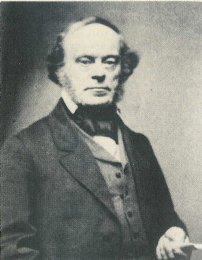
Wikipedia hat in dieser Sprache noch keinen Artikel über diesen Autor. Unten der Text auf Englisch.
Frederic Henry Hedge (December 12, 1805 – August 21, 1890) was a New England Unitarian minister and Transcendentalist. He was a founder of the Transcendental Club, originally called Hedge's Club, and active in the development of Transcendentalism, although he distanced himself from the movement as it advanced.
He was also one of the foremost scholars of German literature in the United States.
Biography
Born in Cambridge, Massachusetts, Hedge was the son of Harvard University professor of logic and metaphysics Levi Hedge. At the age of 12, he traveled to Germany and studied music for five years under the care of George Bancroft. He then entered Harvard as a junior and graduated in 1825. His knowledge of German was to serve him well both in hymnody — he translated Luther's "Ein feste Burg ist unser Gott" ("A Mighty Fortress Is Our God") into the most popular English version — and in philosophy, where it allowed him a greater familiarity with Kant than most of the Americans of his day.
After graduating as valedictorian, he enrolled in Harvard Divinity School, where he met his intimate friend Ralph Waldo Emerson. After graduating from the Divinity School in 1828, Hedge was ordained as a Unitarian minister in 1829, and became minister at a Unitarian church in West Cambridge. In 1835 he took charge of a church in Bangor, Maine; in 1850, after spending a year in Europe, he became pastor of the Westminster Church in Providence, Rhode Island, and in 1856 of the Unitarian church in Brookline, Massachusetts.