Wikipedia hat in dieser Sprache noch keinen Artikel über diesen Autor. Unten der Text auf Englisch.
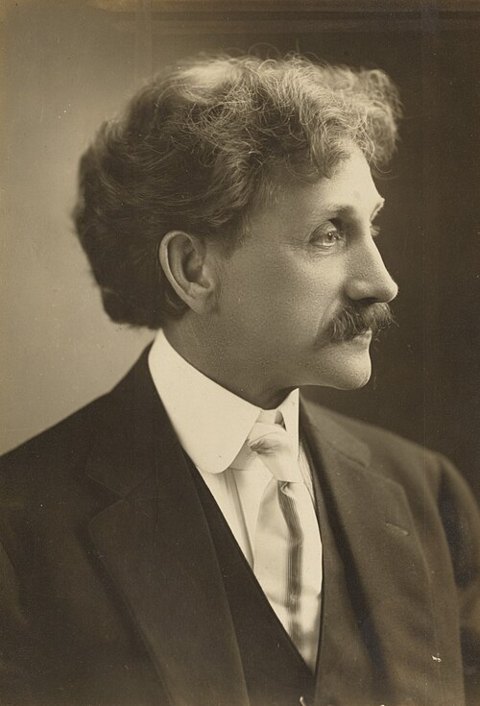
John Howard Moore (December 4, 1862 – June 17, 1916) was an American zoologist, philosopher, teacher, and social reformer who wrote about animal ethics, ethical vegetarianism, humane education, socialism, temperance, and evolutionary biology. In The Universal Kinship (1906), he drew on Darwinian evolutionary theory to argue that the Golden Rule should extend to all sentient beings, rather than humans alone.
Moore was born near Rockville, Indiana, and grew up in Linden, Missouri, before living in Kansas and Iowa. He attended Oskaloosa College, Drake University, and the University of Chicago, earning an A.B. in zoology in 1896. He adopted vegetarianism, rejected Christianity, and became a socialist. At Chicago, he helped found the university's Vegetarian Eating Club and won a national oratorical competition on prohibition. From 1898, he taught at Crane Technical High School and other Chicago schools.
Moore belonged to the Chicago Vegetarian Society and the British Humanitarian League. His books included Better-World Philosophy (1899), The Universal Kinship (1906), The New Ethics (1907), and works on moral education and evolution. His writings circulated among vegetarian, socialist, and humanitarian reformers, including Henry S. Salt, Clarence Darrow, Mark Twain, Jack London, and Eugene V. Debs. He died by suicide in Jackson Park, Chicago, in 1916, following years of illness and chronic pain.