Wikipedia hat in dieser Sprache noch keinen Artikel über diesen Autor. Unten der Text auf Englisch.
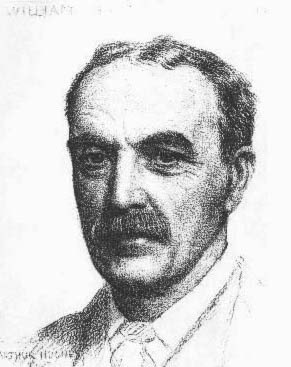
William Hale White (22 December 1831 – 14 March 1913), known by his pseudonym Mark Rutherford, was a British writer and civil servant. His obituary in The Times stated that the "employment of a pseudonym, and sometimes of two (for some of 'Mark Rutherford's' work was 'edited by his friend, Reuben Shapcott'), was sufficient to prove a retiring disposition, and Mr. Hale White was little before the world in person."
Life, career and memorials
White was born in Bedford. His father, William White, a member of the Nonconformist community of the Bunyan Meeting, became well known as a doorkeeper at the House of Commons and wrote sketches of parliamentary life for the Illustrated Times. A selection of his parliamentary sketches was published posthumously, in 1897, by Justin McCarthy, the Irish nationalist MP, as The Inner Life of the House of Commons.
White himself was educated in Bedford at Bedford Modern School, then known as the English School, until the family moved to London. In 1848 he entered the Countess of Huntingdon's College, Cheshunt to train for the Congregational Ministry. He developed increasingly unconventional views and in 1850 wrote to Thomas Carlyle who responded with a full reply encouraging him to stand by his convictions. White later entered New College, London, but the further development of his views prevented him taking up that career and he was expelled for questioning aspects of scripture. Hale White became known as a dissenter.
In 1852 he was employed by John Chapman to work as a personal assistant and subscription tout at The Westminster Review. White was an early proponent of women's rights. Having worked alongside her for The Westminster Review, White was a friend of George Eliot and they both lodged at 142 Strand, London which was owned by John Chapman. White wrote an article about his friendship with George Eliot for The Bookman in August 1902 entitled "George Eliot as I knew her".