Η Βικιπαίδεια δεν έχει ακόμη άρθρο για αυτόν τον συγγραφέα σε αυτή τη γλώσσα. Παρακάτω, το κείμενο στα αγγλικά.
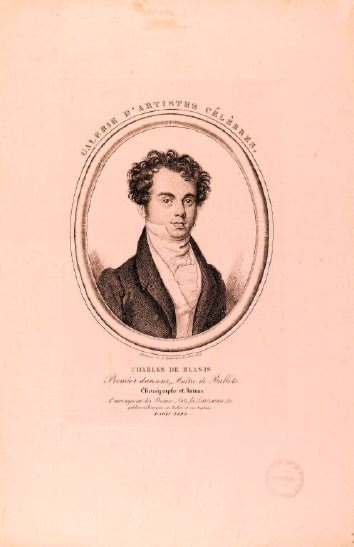
Carlo Blasis (Italian pronunciation: [ˈkarlo ˈblaːzis]; 4 November 1797 – 15 January 1878) was an Italian dancer, choreographer and dance theoretician born in Naples. He is well known for his very rigorous dance classes, sometimes lasting four hours long. He danced in France, Italy, London and Russia. Blasis insisted that his students learn theories and definitions of dance steps. He trained all of Enrico Cecchetti's teachers and it is thought that Blasis's influence in his training is what led Cecchetti to create the Cecchetti method of ballet.
Work
He published an analysis of the ballet techniques in 1820, in a work named Traité élémentaire, théorique, et pratique de l'art de la danse ("Elementary, Theoretical, and Practical Treatise on the Art of the Dance"). He is most known for the pose "Attitude" derived from the famous statue Mercury by Giovanni da Bologna. Enrico Cecchetti expanded his method of instruction and theories.
Even during his own time, Blasis was not best known for his many choreographies (none of which survive today), but for his writings on dance theory. He pioneered the reconciliation of balletic notions like lightness and grace with the geometry and physics of the body in motion. In The Code of Terpsichore, published in 1828, Blasis cataloged a clearly defined "alphabet" of dance poses. This may be the first attempt at a comprehensive systemization of dance.
Blasis radicalized dance theory by relying heavily upon mathematical geometry and physics. He introduced the idea of a "movement axis" – a vertical line through the pose, perpendicular to the floor, that delineates the center of balance of the body.