Η Βικιπαίδεια δεν έχει ακόμη άρθρο για αυτόν τον συγγραφέα σε αυτή τη γλώσσα. Παρακάτω, το κείμενο στα αγγλικά.
Ernest Léon Lajeunesse-Caën, better known as Ernest La Jeunesse (23 June 1874 – 2 May 1917) was a French writer, caricaturist, and literary critic.
Career
Ernest Léon Lajeunesse-Caën was born to Désiré Caën and Céline Feize on 23 June 1874.
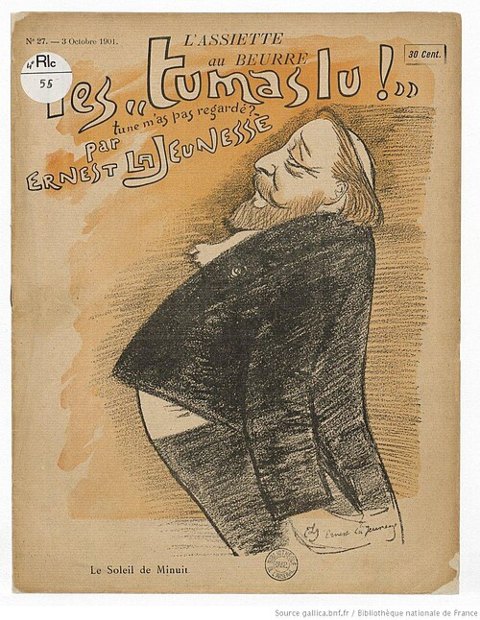
In 1896, after receiving his licence ès lettres (the equivalent of a B.A.), he joined La Revue blanche where he reviewed plays, allying himself with modern writers like Oscar Wilde. He wrote and sometimes drew for Le Figaro, Gil Blas, L'Assiette au beurre, la Revue bleue, La Phalange, L'Intransigeant, Le Journal de Paris. He was also the French correspondent for Die Zeit in Vienna. He excelled in the art of pastiche and had an excellent sense of humor.
In 1906, Guillaume Apollinaire, who appreciated his work, introduced him to Max Jacob. Other great witnesses of the era, such as Paul Léautaud and Jules Renard, discuss La Jeunesse, not always in positive terms; later André Billy would cite him as one of the great chroniclers of his times.
He strove from a very early age to become a playwright, without believing too much in his abilities. However, his dramatic work was defended by Octave Mirbeau who, always quick to defend the underdog, could not tolerate the targeting of a talented young man because of his physical appearance. La Jeunesse had a falsetto voice, and dressed eccentrically. He was caricatured kindly by Alfred Jarry in the character of "Allmensch Severus" in Les Jours et les Nuits. Having discovered his Jewish origins, Léon Daudet called him "a scarecrow" in his Au temps de Judas. According to Edmond de Goncourt, many of his contemporaries feared his viper's tongue and the delicate wickedness of his irony.