

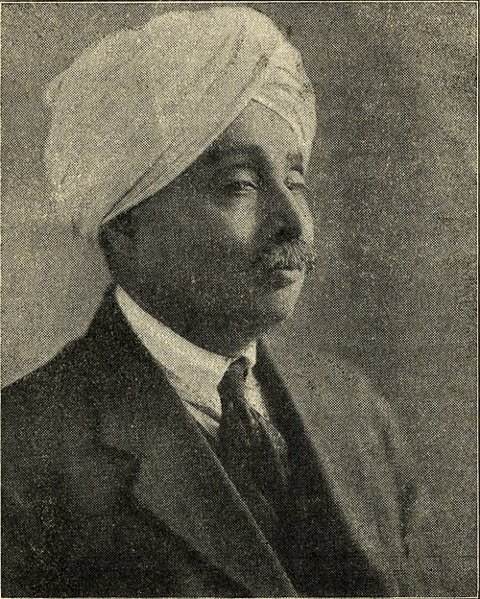
Συγγραφέας
Lala Lajpat Rai
1865–1928
- Γέννηση
- 28 Ιανουαρίου 1865, Dhudike
- Θάνατος
- 17 Νοεμβρίου 1928, Λαχόρη
- Υπηκοότητα
- Βρετανικές Ινδίες
- Ιδιότητα
- Πολιτικός, επαναστάτης, συγγραφέας και μαχητής για την ελευθερία
- Κίνημα
- Κίνημα για την ανεξαρτησία της Ινδίας
Ζωή και έργο
Η Βικιπαίδεια δεν έχει ακόμη άρθρο για αυτόν τον συγγραφέα σε αυτή τη γλώσσα. Παρακάτω, το κείμενο στα αγγλικά.
Lala Lajpat Rai (28 January 1865 - 17 November 1928) was an Indian nationalist revolutionary and author, popularly known as Punjab Kesari. He was one of the three members of the Lal Bal Pal trio. He died of severe trauma injuries sustained in October 1928 during a British-ordered baton charge by police in Lahore, when he led a peaceful protest march against the all-British Simon Commission.
Early life
Lajpat Rai was born on 28 January 1865 into an Agrawal Jain family as the eldest son of six children of Munshi Radha Krishna, an Urdu and Persian government school teacher and Gulab Devi Aggarwal at Dhudike in the Faridkot district of the Punjab Province of British India (now in Moga district, Punjab, India). He spent much of his youth in Jagraon. His house still stands in Jagraon and houses a library and museum.
Education
Lajpat Rai had his initial education in Government Higher Secondary School, Rewari, Punjab province, where his father was posted as an Urdu teacher. In 1880, he joined Government College at Lahore to study law, where he came in contact with patriots and future freedom fighters, such as Lala Hans Raj and Pandit Gurudutta. While studying at Lahore he was influenced by the Hindu reformist movement of Swami Dayanand Saraswati, became a member of the existing Arya Samaj Lahore (founded 1877) and founder-editor of Lahore-based Arya Gazette.
Law
In 1884, his father was transferred to Rohtak, and Rai came along after the completion of his studies at Lahore. In 1886, he moved to Hisar where his father was transferred, and started to practice law and became a founding member of the Bar Council of Hisar along with Babu Churamani. In the same year, he helped Mahatma Hansraj establish the nationalistic Dayananda Anglo-Vedic School, Lahore, and he also founded the Hisar district branches of the Indian National Congress, and the reformist Arya Samaj movement with several other local leaders. These included Babu Churamani (lawyer), the three Tayal brothers (Chandu Lal Tayal, Hari Lal Tayal and Balmokand Tayal), Dr. Ramji Lal Hooda, Dr. Dhani Ram, Arya Samaj Pandit Murari Lal, Seth Chhaju Ram Jat (founder of Jat School, Hisar) and Dev Raj Sandhir. In 1888 and again in 1889, he had the honour of being one of the four delegates from Hisar to attend the annual session of the Congress at Allahabad, along with Babu Churamani, Lala Chhabil Das and Seth Gauri Shankar. In 1892, he moved to Lahore to practise before the Lahore High Court. To shape the political policy of India to gain independence, he also practised journalism, and was a regular contributor to several newspapers including The Tribune. He was also associated with the management of the Punjab National Bank and Lakshmi Insurance Company in their early stages in 1894.
Κείμενο: “Lala Lajpat Rai”, από τη Βικιπαίδεια, την ελεύθερη εγκυκλοπαίδεια, με την άδεια CC BY-SA 4.0. Ημερομηνίες και στοιχεία: Wikidata.
Συλλογή
Βιβλία: Lala Lajpat Rai
2 βιβλία
Ανθρωπιστικές επιστήμες
The Political Future of India
Lala Lajpat Rai