Η Βικιπαίδεια δεν έχει ακόμη άρθρο για αυτόν τον συγγραφέα σε αυτή τη γλώσσα. Παρακάτω, το κείμενο στα αγγλικά.
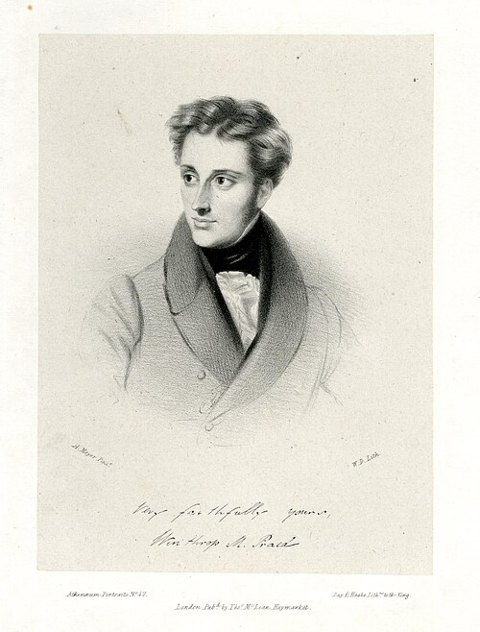
Winthrop Mackworth Praed (28 July 1802 – 15 July 1839)—typically written as W. Mackworth Praed—was an English politician and poet.
Early life
Praed was born in London, United Kingdom. The family name of Praed was derived from the marriage of the poet's great-grandfather to a Cornish heiress. Winthrop's father, William Mackworth Praed, was a serjeant-at-law (1756–1835) and a revising barrister for Bath. His mother belonged to the English branch of the New England family of Winthrop.
In 1814 Praed was sent to Eton College, where he founded a manuscript periodical called Apis matina. This was succeeded in October 1820 by the Etonian, a paper projected and edited by Praed and Walter Blount, which appeared every month until July 1821, when the chief editor, who signed his contributions "Peregrine Courtenay," left Eton, and the paper died. Henry Nelson Coleridge, William Sidney Walker, and John Moultrie were the three best known of his collaborators on this periodical, which was published by Charles Knight, and of which details are given in Knight's Autobiography and in Henry Maxwell Lyte's Eton College.
Before Praed left school he had established, over a shop at Eton, a "boys' library," the books of which were later amalgamated in the School Library. His career at Trinity College, Cambridge was a brilliant one. He gained the Browne medal for Greek verse four times and the Chancellor's Gold Medal for English verse twice in 1823 and 1824. He was bracketed third in the classical tripos in 1825, won a fellowship at his college in 1827, and three years later carried off the Seatonian prize. At the Union his speeches were rivalled only by those of Macaulay and of Charles Austin, who subsequently made a great reputation at the parliamentary bar. The character of Praed during his university life is described by Bulwer-Lytton in the first volume of his Life.