Wikipédia n'a pas encore d'article sur cet auteur dans cette langue. Ci-dessous, le texte en anglais.
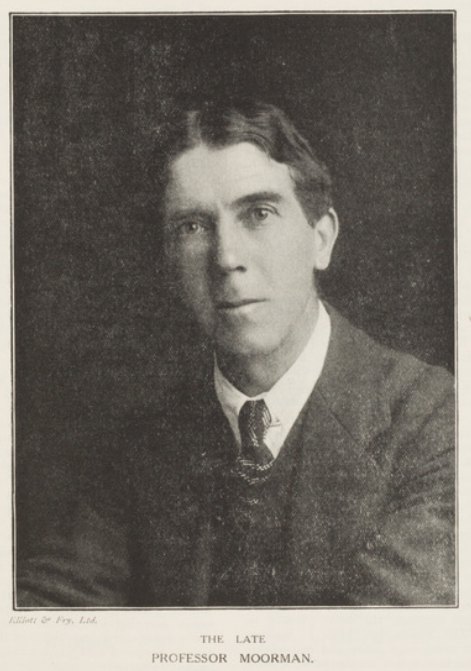
Frederic William Moorman (1872–1919) was a poet and playwright, and Professor of English Language at the University of Leeds from 1912 to 1918.
Biography
Moorman grew up in Devon. He married Frances Beatrice Humpidge (1867–1956) and was the father of John Moorman, who would become Bishop of Ripon.
Academic and writing
Following university study in Strasbourg, Moorman joined the staff of the Yorkshire College, Leeds, in 1898; the Yorkshire College subsequently became the University of Leeds in 1904. When a new Chair was instituted in 1912, Moorman was appointed the university's first Professor of English Language.
Moorman edited the 1912 edition of Shakespeare's The Winter's Tale for the Arden Shakespeare project, published by Methuen, and in 1915 edited The Poetical Works of Robert Herrick for Oxford University Press. Moorman was associated with the Workers' Educational Association and compiled several books of traditional Yorkshire stories and poems, some in the Yorkshire dialect, alongside scholarly works such as The Place-Names of the West Riding of Yorkshire, The Publications of the Thoresby Society, and 18 (Leeds: The Thoresby Society, 1910).
In his 1914 essay for the English Association, ‘English Place Names and the Teutonic Sagas’, Moorman suggested his research indicated that Yorkshire was not settled by Angles or Saxons after the end of rule Roman in AD 383, but by a different Germanic tribe, the Geats. As a consequence, he claimed, it is possible the first work of English literature, Beowulf, believed to have been composed by Geats, was written in Yorkshire. This interest in Yorkshire's cultural and linguistic history was to be of particular interest to one of Moorman's students at Leeds University, the poet, novelist and art critic Herbert Read. Read described Moorman as 'the most inspiring teacher in the university.' As a result of his enthusiasm for Moorman, Read also wrote two Yorkshire dialect plays which he gave as a gift to Moorman some time shortly before the First World War.