Wikipédia n'a pas encore d'article sur cet auteur dans cette langue. Ci-dessous, le texte en anglais.
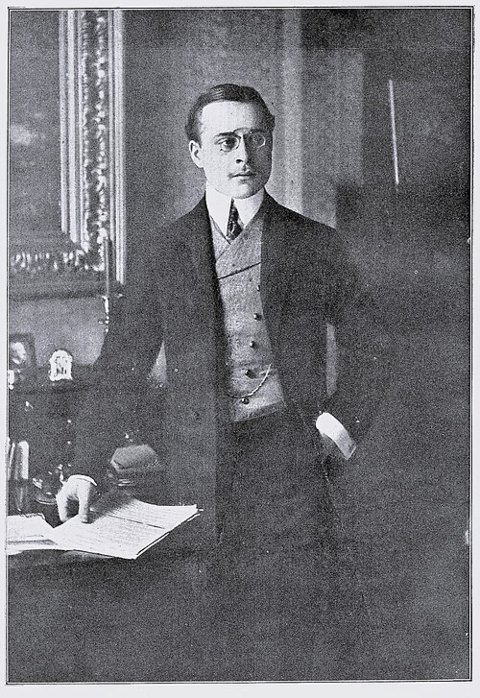
Fritz Oswald Bilse (31 March 1878 in Kirn, Rhine Province – 1951) was a German novelist, playwright and a lieutenant in the Prussian Army. He also used the pseudonyms Fritz von der Kyrburg and Fritz Wernthal.
Life
Fritz Oswald Bilse was born in Kirn (present-day Rhineland-Palatinate, then Prussian Rhine Province), the son of a schoolteacher, and grew up in the towns of Kirn and Eisenach. He joined the Prussian army in 1896, and in 1900 was posted with the 16. Train-Bataillon at Forbach in Lorraine. He rose to instant notoriety with his novel Aus einer kleinen Garnison. Ein militärisches Zeitbild (1903). In later editions, he used the pseudonym "Fritz von der Kyrburg", after his home town's most prominent landmark, the Kyrburg castle.
The book, in which Bilse satirizes the manners of the Forbach garrison and of the Prussian army in general, became a succès de scandale and was soon reprinted many times. Bilse's criticism, however, was so sharp, and the location and protagonists so little disguised, that several officers who felt their honour to be under attack prosecuted Bilse in a court-martial, the trial taking place at Metz from 9. to 13. November 1903. Bilse was found guilty of defamation of character, was discharged from the army dishonourably, and sentenced to six months' imprisonment. His novel was (temporarily) banned.
The scandal only served to enhance Bilse's celebrity. He was henceforth described as the German army's enfant terrible; the novel became popular abroad, especially in France, where the label interdit en Allemagne was recognized as a badge of quality. Translations soon appeared, into French and also into English, the latter appearing in 1904 containing a detailed account of the court-martial and a foreword by the German-American author Theodore Dreiser, who praised Bilse as a great realist. The book was also translated into other languages, e.g. into Dutch and Russian.