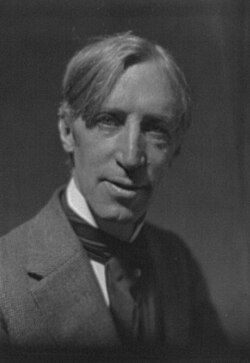
Wikipédia n'a pas encore d'article sur cet auteur dans cette langue. Ci-dessous, le texte en anglais.
Gerald Stanley Lee (October 4, 1862 – April 3, 1944) was an American writer and minister. He began his career as a clergyman in New England and the Midwest, becoming a full-time writer in 1896. Lee's writing focused on contemporary cultural developments such as the rise of mass media and technology.
Early life and education
Gerald Stanley Lee was born on October 4, 1862, in Brockton, Massachusetts. He attended Oberlin College, Middlebury College (graduating in 1885), and Yale Divinity School.
Career
Until 1896, Lee worked as a minister in New England and Minnesota. After 1896, he was a full-time writer. His first book, The Shadow Christ, was published that year. According to critic Ryan Jay Friedman, Lee's writing in the 1910s argued that Christian education was similar to mass media including advertising, in that both attempted to persuade people to "choose a particular 'good'".
Jo-Anne Pemberton compares Lee's The Voice of the Machines: An Introduction to the Twentieth Century (1906) with the works of Filippo Tommaso Marinetti and futurism.
Crowds: A Moving-Picture of Democracy (1913) argues that media can be used to develop a more cohesive polity. When Crowds was released in 1913, Lee wrote in a letter to Theodore Roosevelt that he hoped that it would be "the text-book of the Progressive Movement". According to Russ Castronovo, who calls Crowds a "crazy sort of book", the book argues for modern mass media as tools for democracy because they prioritize the present and thereby fuel modernization.
Lee opposed U.S. entry into World War I, writing essays and editorials characterizing the war as a clumsy effort of the nations involved to communicate their desires and one that could be settled without any U.S. intervention. This drew a harsh rebuke from G. K. Chesterton, who criticized Lee for imagining that the war then underway could be ended by mere discussion and for treating the warring forces as if they were on equal moral footing.