Wikipédia n'a pas encore d'article sur cet auteur dans cette langue. Ci-dessous, le texte en anglais.
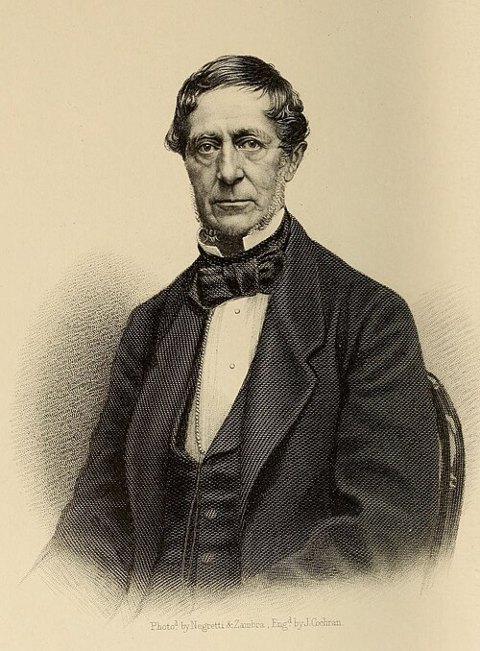
Henry Dircks FRSE FCS (26 August 1806– 17 September 1873) was an English engineer who is considered to have been the main designer of the projection technique known as Pepper's ghost in 1858. It is named after John Henry Pepper who implemented a working version of the device in 1862. Dircks also investigated attempts at the invention of a perpetual motion device, writing that those who sought to create such a thing were "half-learned" or "totally ignorant".
Life and career
Dircks was born in Liverpool on 26 August 1806.
He was apprenticed to a mercantile firm and spent much of his free time studying practical mechanics, chemistry, and literature. Around the mid-1820s he began lecturing about chemistry and electricity while writing literary articles in the local press and scientific papers in the Mechanics' Magazine and other journals. In 1837 he became a life member of the British Association, and afterwards contributed papers to its proceedings. Two years later he wrote a pamphlet regarding a proposed union of mechanics' and literary institutions. He also wrote a short treatise entitled Popular Education, a series of Papers on the Nature, Objects, and Advantages of Mechanics' Institutions, first printed in Liverpool in 1840. In 1843, Dircks and Thomas Hoblyn wrote an overview of the smokeless argand furnace, which was created by Charles Wye Williams in an attempt to solve the issue of smoky air in London.
He became a practical engineer, conducting railway, canal, and mining works, before progressing to the role of consulting engineer. He continued to investigate technologies and invent new devices, taking out several patents between 1840 and 1857. Dircks joined the Royal Society of Literature, the Royal Society of Edinburgh, and other scientific bodies. In 1867 he was elected a full Fellow of the Royal Society of Edinburgh, his proposer being William John Macquorn Rankine.