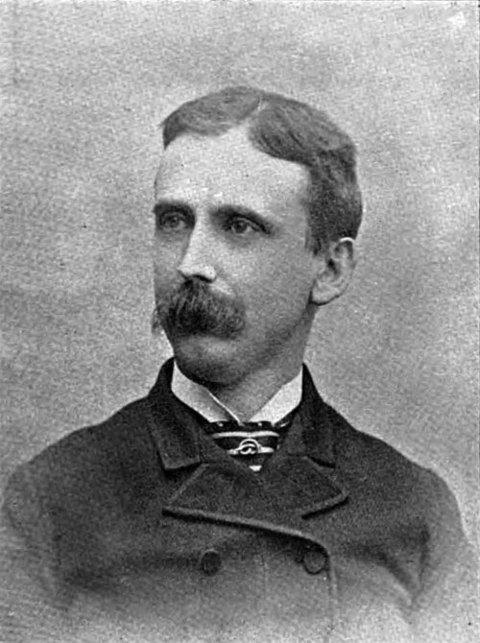
Wikipédia n'a pas encore d'article sur cet auteur dans cette langue. Ci-dessous, le texte en anglais.
Julius Chambers, F.R.G.S., (November 21, 1850 – February 12, 1920) was an American author, editor, journalist, travel writer, and activist against psychiatric abuse.
Life and works
Julius Chambers was born in Bellefontaine, Ohio on November 21, 1850, the son of Joseph and Sarabella (née Walker) Chambers. When he was only eleven years old, he began working as a printer's devil in his uncles' newspaper office, the Bellefontaine Republican. He first attended Ohio Wesleyan University, and later, Cornell University, from which he graduated in 1870. At Cornell, he was a co-founder in 1869 of the Irving Literary Society. Around 1880, while working as a journalist he spent some time reading law in Philadelphia with Benjamin H. Brewster, who became U.S. Attorney General in December 1881, and studying at Columbia College Law School in New York City.
New York Tribune
After graduating from Cornell, he became a reporter on the New York Tribune until 1873.
Geographic discovery
While on sick leave on June 4, 1872, Chambers discovered Elk Lake adjoining Lake Itasca in Clearwater County, Minnesota, in the Lake District of Northwestern Minnesota. He declared it to be the ultimate origin of the Mississippi River. For this discovery, he was made a Fellow of the Royal Geographical Society. This led to a series of newspaper articles and the book The Mississippi River and Its Wonderful Valley (1910).
Investigative journalism
Later in 1872, he returned to work and undertook a journalistic investigation of Bloomingdale Asylum, having himself committed with the help of some of his friends and the city editor. His intent was to obtain information about alleged abuse of inmates. After ten days, his collaborators on the project had him released. When articles and accounts of the experience were published in the Tribune, it led to the release of twelve patients who were not mentally ill, a reorganization of the staff and administration of the institution and, eventually, to a change in the lunacy laws. This later led to the publication of the book A Mad World and Its People (1876). From this time onward, Chambers was frequently invited to speak on the rights of the mentally ill and the need for proper facilities for their accommodation, care and treatment.