Wikipédia n'a pas encore d'article sur cet auteur dans cette langue. Ci-dessous, le texte en anglais.
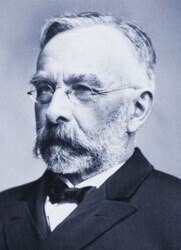
Karl Wilhelm Bücher (16 February 1847, Kirberg, Hesse – 12 November 1930, Leipzig, Saxony) was a German economist, one of the founders of non-market economics, and the founder of journalism as an academic discipline.
Early life
Karl Bücher was born in Kirberg, a small village in Hesse, as the son of a small, not very successful brushmaker and farmer; his grandfather Philipp was a cabinet-maker. Karl's mother, Christiane née Dorn, was the daughter of a baker. Bücher attended a private preparatory school with a Pastor in nearby Dauborn and 1863–1866 the Catholic Gymnasium in Hadamar, where he was primus omnium. A former teacher of Bücher's recommended he attend university and, after much discussion, Bücher's parents finally consented.
Later years
Bücher studied at the University of Bonn (also part of Prussia), concentrating on History and Classics, with the aim to become a Gymnasium teacher. Bücher's most important professor was the Ancient Historian Arnold Schäfer. For a while, he was a private tutor in Heppenheim to finance his studies, and then continued in Göttingen and Bonn, culminating in 1870 in a Dr.phil. (Ph.D.) in History and Epigraphy with a (published) dissertation entitled De gente Aetolica amphictyoniae participe. After spending some time as a gymnasium teacher and journalist, especially in Frankfurt where he was famous for his liberal, anti-Bismarck views, Bücher decided to opt for academe and took his Habilitation at the Ludwig-Maximilians-Universität München.
In 1882, Bücher was elected by the faculty to an extraordinary professorship at the University of Erlangen, Bücher failed to receive Ministerial approval. However, he also received and accepted a call to a Chair at the University of Tartu (then Dorpat), the German-language university in the then Russian province of Livonia. The call enabled him to marry his fiancée at the time Emilie Mittermaier.