Wikipédia n'a pas encore d'article sur cet auteur dans cette langue. Ci-dessous, le texte en anglais.
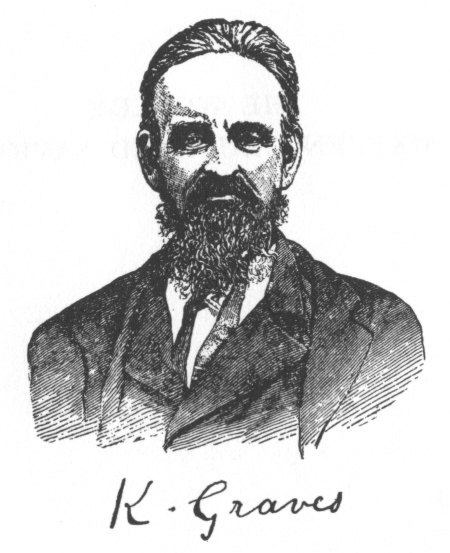
Kersey Graves (November 21, 1813 – September 4, 1883) was a skeptic, atheist, rationalist, spiritualist, reformist writer, who was popular on the American freethought circuit of the late 19th century.
Life
Graves was born in Brownsville, Pennsylvania. His parents were Quakers, and as a young man he followed them in their observance, later moving to the Hicksite wing of Quakerism. According to one source, Graves did not attend school for more than three or four months in his life, but another source says that he received an "academical education", and at the age of 19 was teaching in a school at Richmond, a career he was to follow for more than twenty years.
He was an advocate of Abolitionism, also interested in language reform, and became involved with a number of radical freethinkers within Quakerism. In August 1844, he joined a group of about fifty utopian settlers in Wayne County, Indiana. In the same month, he was disowned by his Quaker meeting group due to his neglect of attendance, and also setting up a rival group. The groups he was associated with later dabbled in mesmerism and spiritualism.
In July 1845, Graves married the Quaker, Lydia Michiner, at Goschen Meeting House, in Zanesfield, Logan County, Ohio, and they later had five children at their home in Harveysburg, Ohio. They later moved back to Richmond and bought a farm.
The Goschen Meeting House was a centre of the Congregational Friends and were involved with Temperance and Peace, health reform, anti-slavery, women's rights and socialistic utopianism.