Wikipédia n'a pas encore d'article sur cet auteur dans cette langue. Ci-dessous, le texte en anglais.
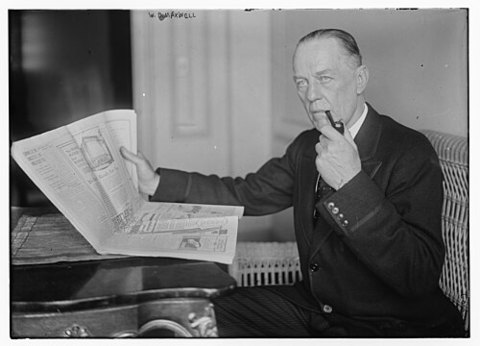
William Babington Maxwell (1866–1938) was a British novelist and playwright.
Early life
Born on 4 June 1866, William Babington Maxwell was the son of novelist Mary Elizabeth Braddon and Irish businessman John Maxwell. The family lived at Lichfield House, Richmond, spending holidays in the New Forest. Maxwell's formal education ended at the age of 14 as his mother had a fear of 'over-education'.
Career
Originally training as an artist, Maxwell turned his back on art and began to write short stories to help cope with depression. His first story was published in The World by Edmund Yates for £5. He also wrote stories for Truth and Temple Bar. On his coming of age, his father gave him control of the failing magazine Mistletoe Bough which he tried unsuccessfully to turn around. He wrote The Last Man In, a drama, produced 14 March 1910, at the Royalty Theatre, Glasgow, by the Scottish Repertory Company; and, with George Paston (i.e. Emily Morse Symonds), a farce, The Naked Truth, which was first played at Wyndham's Theatre, London in April 1910, and in which Charles Hawtrey played Bernard Darrell. His 1913 novel The Devil's Garden was banned by the Libraries Association.
He was a friend of Edward VII whom he described as "the biggest swell in Europe".
First World War
Though nearly 50 years old at the outbreak of the First World War, Maxwell was accepted as a lieutenant in the Royal Fusiliers and served in France until 1917. His military career began at a recruitment station in a building under Govett and Sons in Throgmorton Street, London. He was tasked with recruiting 1000 men but was successful in recruiting 1300. From there onwards, the battalion he helped form was sent to Colchester for training. Maxwell was given care of the battalion funds which related to officers, rations and weights. In his notebook dated 1916, he noted a list of rations and weights for soldiers and animals. Maxwell was promoted to Lieutenant on 3 September 1914. From Colchester, Maxwell continued training, moving to Andover and Salisbury Plain before being sent to the front line in 1915. In his autobiography, Time Gathered, under the chapter 'Wasted Years', Maxwell talks about his time as a Regimental Transport Officer, transporting men, equipment, bombs and machine guns to the front line, alongside food and water. He was stationed at Berles-Aux-Bois, a mile from the front line and fought in the Battle of the Somme.