Wikipedia non ha ancora una voce su questo autore in questa lingua. Di seguito, il testo in inglese.
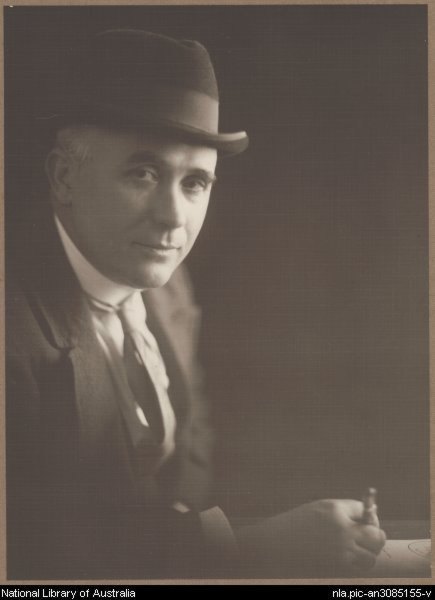
Edward George Dyson (4 March 1865 – 22 August 1931) was an Australian journalist, poet, playwright and short story writer. He was the elder brother of illustrators Will Dyson (1880–1938) and Ambrose Dyson (1876–1913), with three sisters also of artistic and literary praise.
Dyson wrote under several – some say many – nom-de-plumes, including Silas Snell. In his day, the period of Australia's federation, the poet and writer was "ranked very closely to Australia's greatest short-story writer, Henry Lawson". With Lawson known as the "swagman poet", Ogilvie the "horseman poet", Dyson was the "mining poet". Although known as a freelance writer, he was also considered part of The Bulletin writer group.
Early life
He was born at Morrison's Diggings near Ballarat in March 1865, to George Dyson and Jane, née Mayall. Brother Will would marry Ruby Lindsay while Ruby's brother Lionel would marry the Dyson sister Jean.
He was educated at the government schools in those towns until the age of thirteen. Whereas others his age were exploring the bush, he was examining abandoned mine shafts and associated buildings. He and his child friends would also be fossicking and re-washing hillsides.
At a 12-year-old he began to work as an assistant to a travelling draper (leading to the 1911 poem "Tommy the hawker") as well as various jobs "below and on top" in the Victorian and Tasmanian goldfields: Driving a whim horse at Ballarat, mining at Clunes and Bungaree, and panning shallow alluvial for gold at Lefroy, Tasmania, and on the Pinafore field, finding its largest nugget. His young working life also saw Dyson as a drover. Returning to Smeaton and Gordon, he was a trucker in a deep mine, then working in the battery building. About 1883 the family settled in South Melbourne, where he became a factory hand.