Wikipedia non ha ancora una voce su questo autore in questa lingua. Di seguito, il testo in inglese.
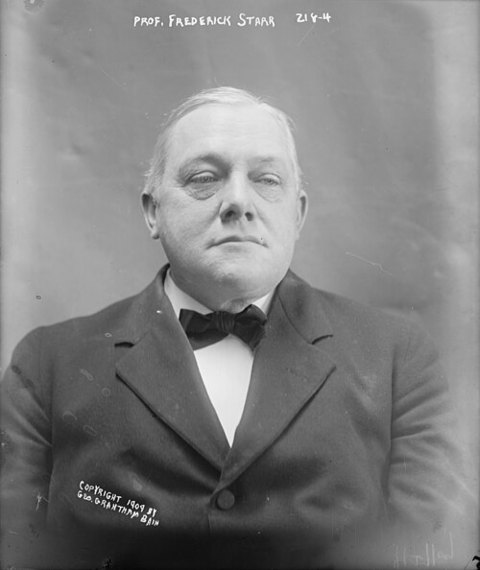
Frederick Starr (September 2, 1858 – August 14, 1933) was an American anthropologist and "populist educator" born in Auburn, New York. He was the fourth son of a Missouri clergyman and abolitionist Frederick Starr.
As he was avid collector of charms (ofuda) and votive slips (senjafuda or nōsatsu) he was called Dr. Ofuda (お札博士, Ofuda Hakushi/ Hakase) in Japan. He sold much of this collection to art collector and museum specialist Gertrude Bass Warner, and it currently resides at the Jordan Schnitzer Museum of Art at the University of Oregon and the University of Oregon Knight Library Special Collections & University Archives.
Biography
Starr earned an undergraduate degree at the University of Rochester (1882) and a doctorate in geology at Lafayette College (1885). While working as a curator of geology at the American Museum of Natural History (AMNH) in New York, he became interested in anthropology and ethnology. Frederic Ward Putnam helped him become appointed as curator of AMNH's ethological collection (1889–1891).
In this period, he became active in the Chautauqua circuit as a popular professor and, in 1888–89, as registrar. When William Rainey Harper, president of the Chautauqua Institution, was named President of the University of Chicago, he appointed Starr as an assistant professor of anthropology there.
Starr moved to the University of Chicago in 1891; he served in its faculty for the next 31 years. He was an Assistant professor (1892–1895), and he gained tenure in 1896. He also served as the Curator of the anthropological section of the University's Walker Museum.