Wikipedia non ha ancora una voce su questo autore in questa lingua. Di seguito, il testo in inglese.
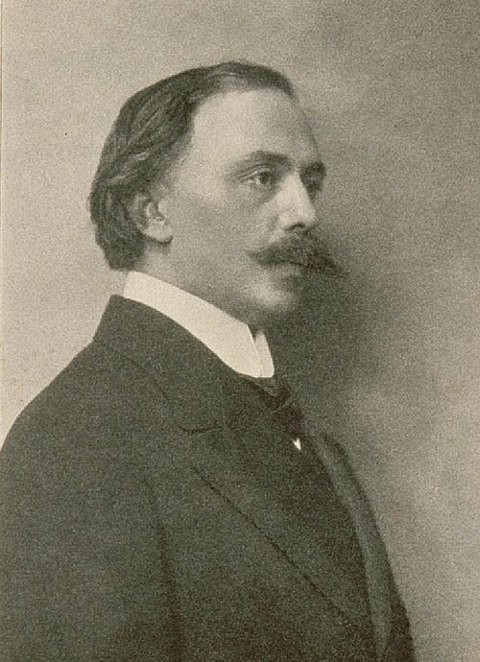
Friedrich Lienhard (4 October 1865 – 30 April 1929) was a German writer and nationalist ideologue.
Life
Born in Rothbach near Haguenau in Alsace, Lienhard became the eldest son of the village schoolmaster Friedrich Lienhard. He was born in what was then the French Empire, but the area was incorporated into the new German Empire when he was about five.
His mother Elisabeth (née Gutbub) died in 1877. In addition to his brother Albert, who was one year younger and later became a pastor, Lienhard had five half-brothers and sisters from his father's second marriage. From 1874 to 1886, he attended the grammar schools in Bouxwiller and Schillersdorf. From 1884, Lienhard studied Protestant theology in the University of Strasbourg. He broke off this study after four semesters to study literature and history at the Humboldt University of Berlin. In 1885, Lienhard joined the Wingolf Connection Argentina to Strasbourg and in 1887 the Berliner Wingolf. After three semesters he also broke off his second degree course.
He then turned to writing. As an independent writer, he earned his living as a tutor in Lichterfelde near Berlin. From April 1893 until October 1894, he was chief editor of the anti-Semitic monthly Das zwanzigste Jahrhundert. Blätter für deutsche Art und Wohlfahrt.
In 1900, together with Adolf Bartels, he became editor of the magazine Deutsche Heimat, a medium for "literature and folklore", for a few months. It was an ideological platform for the protagonists of the folk-nationalist Heimatkunst movement. Bartels and Lienhard formed the centre of this movement, their common ideological references were the writings of Paul de Lagarde and August Julius Langbehn. Lienhard rejected the common biological and ethnic racial categories and developed his own racial theory. He hoped to achieve "imperial inspiration" through a close connection between Christianity and Germanity. The "solution of the Jewish question" and the prevention of "left-wing mob rule", which seemed urgent to him as well, he saw in the assumption of "leadership" by a "noble race of great souls" with the "qualities of goodness, warmth and love". This by no means excluded anti-Semitism. For example, this is what the völkisch oriented "Weihespiel" Ahasver on the Rhine stands for. Trauerspiel aus der Gegenwart (1914). As an Alsatian, he was one of those German-speaking authors "who excelled in claiming the respective region as 'German' in their works." (Kay Dohnke). Finalely, the literary scholar Andreas Schumann concludes that the historical value references in Lienhard's work combine "Germanic, antique and Christian elements into a German-national model" which was "racially charged" and claimed a "German cultural hegemony" in Europe. Lienhard's German studies can be classified as "war German studies". Lienhard was directly involved in war propaganda through various publications, such as