Wikipedia non ha ancora una voce su questo autore in questa lingua. Di seguito, il testo in inglese.
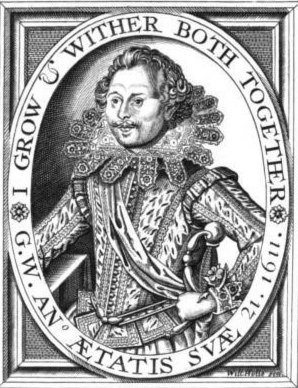
George Wither (11 June 1588 O.S. (21 June 1588 NS) – 2 May 1667 O.S. (12 May 1667 NS)) was a prolific English poet, pamphleteer, satirist, and writer of hymns. Wither's life spanned one of the most tumultuous periods in the history of England, during the reigns of Elizabeth I, James I, and Charles I, the Civil War, the Parliamentary period, and the Restoration period.
Early life
Wither was born in Bentworth, near Alton, in the heart of Hampshire, the son of George Wither Senior and his wife, Mary. His grandfather, Richard Wither, lived at Manydown in Wootton St Lawrence, where the family had resided since at least 1344. His early schooling took place under Rev. John Greaves, the father of John, Sir Edward and Thomas Greaves. Between the ages of fifteen and seventeen, he studied at Magdalen College, Oxford. Despite his neighbours' advice that his father put him to some mechanic trade, Wither was sent to one of the Inns of Chancery, eventually obtaining an introduction at Court.
It is thought that Wither spent some time in Ireland, perhaps with Adam Loftus at Rathfarnham Castle. He wrote what amounted to a masque for a wedding that took place there in 1610, of the parents of Francis Willughby.
Wither wrote a 1612 elegy on the death of Henry Frederick, Prince of Wales, and a 1613 volume of congratulatory poems on the marriage of the princess Elizabeth.
Imprisonment and release
Some time between 1611 and 1613, Wither wrote Abuses Stript and Whipt, twenty satires directed against the concepts of revenge, ambition, and lust. These satires, aimed at exposing "th'abuses of these wicked Times", achieved some popular success and had seven printings from 1613 to 1617. The volume included a poem called "The Scourge", in which the Lord Chancellor was attacked, and a series of epigrams. Despite the fact that the satires referenced nobody by name and that Wither had published them a year before with no trouble, he was arrested for libel "on or about 20 March 1614" and held in the Marshalsea prison for four months before being released.