Wikipedia non ha ancora una voce su questo autore in questa lingua. Di seguito, il testo in inglese.
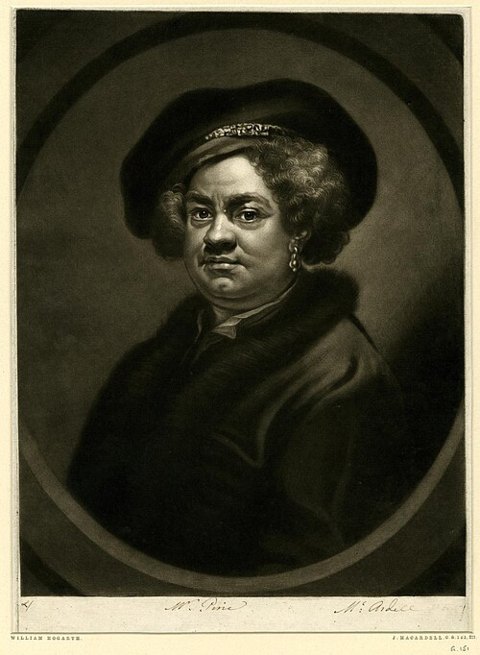
John Pine (1690–1756) was an English engraver, print-seller with a shop on St Martin's Lane in London, print publisher, and cartographer notable for his artistic contribution to the Augustan style and Newtonian scientific paradigm that flourished during the British Enlightenment.
Early life and apprenticeships
Little is known of Pine's parents or ancestry. Biographical sketches frequently refer to him as black or of African ancestry, especially in the lore of Freemasonry, a society with which he became affiliated. However, the United Grand Lodge of England has not been able to verify such claims.
Pine began his career as an apprentice goldsmith. He was also apprenticed to the French engraver Bernard Picart (1673–1733), who was associated with a movement described by historian Margaret Jacob as the "Radical Enlightenment".
Career
Pine was a close friend of William Hogarth, who also began his career as an engraver. It appears likely that their careers were mutually reinforcing, even though Pine remained principally in the field of engraving while Hogarth became a famous painter. Hogarth painted Pine several times; once, in his 1749 engraving The Gate of Calais, depicting him as a fat friar. Both men served as governors of the Foundling Hospital, and both were Freemasons, a social affiliation that was also a means of marketing their talents. Pine was a member of the Lodge that met at the Horn Tavern in Westminster and joined with other Lodges to form the Grand Lodge in 1717.
Pine engraved the frontispiece of the 1723 Constitutions of the Free-Masons, which elevated his status as an artist and secured his position as principal engraver for the Grand Lodge. Subsequent work for the Grand Lodge included annual engraved lists of member Lodges, which provided details about the time and place of their meetings. These engravings included miniature signs for each Lodge symbolizing their meeting place, usually a tavern. Pine's work is an essential part of the record of early Freemasonry. He also engraved the first List of Lodges published in 1723.