Wikipedia non ha ancora una voce su questo autore in questa lingua. Di seguito, il testo in inglese.
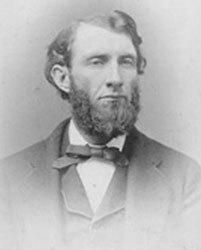
John William Burgess (August 26, 1844 – January 13, 1931) was an American political scientist. He spent most of his career at Columbia University where he in 1880 created the first graduate school in Political Science. He has been described as "the most influential political scientist of the period" and "the father of American political science."
Early life and education
Burgess was born in Cornersville, Tennessee, on August 26, 1844. His father was a staunch Whig and part of the Tennessee planter aristocracy. His family, which held slaves, were unionists during the American Civil War, believing that slavery could more easily be maintained within a union with Northern states where the Northern states had to return fugitive slaves to the South.
He attended Cumberland University in Lebanon, Tennessee, from September 1861 until February 1862 when Burgess and other students fled as the Union army occupied parts of Tennessee. In 1862, Burgess sought to avoid conscription into the Confederate States Army. He escaped to Union-held territory where he was required to take an oath of allegiance to the Union. Burgess subsequently entered into the Union Army in 1862 and was stationed in West Tennessee.
He undertook study of history at Amherst College, graduating in 1867. He gained admission to the bar in 1869.
Career
From 1869 to 1871, he was Professor of English literature and political economy at Knox College.
From there he attended the universities of Göttingen, Leipzig, and Berlin over the period 1871–1873, where he studied under scholars including the historian Johann Gustav Droysen; the economist Wilhelm Roscher; the historian Theodor Mommsen, whose linking history with law strongly influenced Burgess's own approach; and Rudolf von Gneist. He was much influenced by the training in research methods characteristic of German universities of the time. He sought to import these methods of research and scholarship, first to Amherst (unsuccessfully) and later to Columbia. He maintained a lifelong interest in German-American relations.