Wikipedia non ha ancora una voce su questo autore in questa lingua. Di seguito, il testo in inglese.
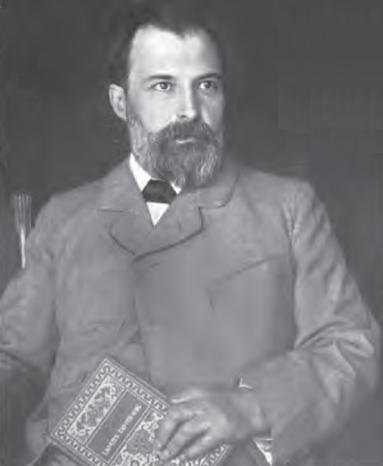
Paul Carus (German: [ˈpaʊl ˈkaːʁʊs]; 18 July 1852 – 11 February 1919) was a German-American author, editor, philosopher, and student of comparative religion.
Life and education
Carus was born in Ilsenburg and attended the Stettin Gymnasium where he studied mathematics under Hermann Grassmann. He later studied at the universities of Strassburg (then Germany, now France) and Tübingen, Germany. After obtaining his PhD from Tübingen in 1876 he served in the army and then taught school. He had been raised in a pious and orthodox Protestant home, but gradually moved away from this tradition.
He left Bismarck's Imperial Germany for the United States, "because of his liberal views". After he emigrated to the United States (in 1884) he lived in Chicago, and in LaSalle, Illinois. Paul Carus married Edward C. Hegeler's daughter, engineer Mary Hegeler (Marie) and the couple later moved into the Hegeler Carus Mansion, built by her father. They had seven children, the firstborn, Robert died at birth, but Edward (b. 1890), Gustave (b. 1892), Paula (b. 1894), Elisabeth or "Libby" (b. 1896), Herman (b. 1899), and Alwin (b. 1901) all lived long lives. Mary ran the family business, Matthiessen-Hegeler Zinc Company and the Open Court business and later took on the editorial role after Carus's death, alongside their daughter Elizabeth.
Career
In the United States, Carus briefly edited a German-language journal and wrote several articles for the Index, the Free Religious Association organ.
Soon after, he became the first managing editor of the Open Court Publishing Company, founded in 1887 by his father-in-law. The goals of Open Court were to provide a forum for the discussion of philosophy, science, and religion, and to make philosophical classics widely available by making them affordable.