Wikipedia non ha ancora una voce su questo autore in questa lingua. Di seguito, il testo in inglese.
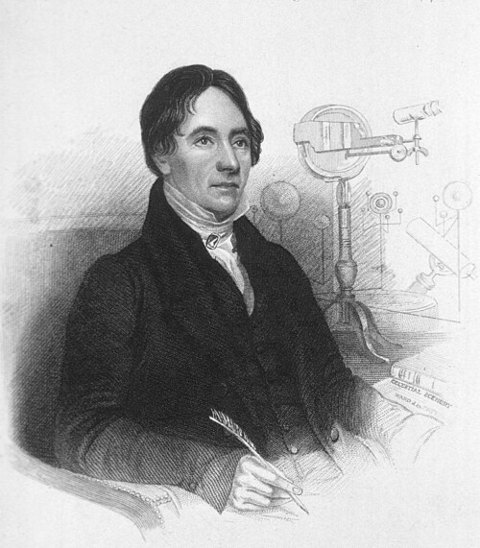
Reverend Thomas Dick (24 November 1774 – 29 July 1857), was a British church minister, science teacher and writer, known for his works on astronomy and practical philosophy, combining science and Christianity, and arguing for a harmony between the two.
Early life
Thomas was brought up in the strict tenets of the Presbyterian United Secession Church of Scotland. His father, Mungo Dick, was a small linen manufacturer, and he raised Thomas to work in this trade. When he was nine years old, he saw a brilliant meteor and this sparked a passion for astronomy. He read, sometimes even when seated at the loom, every book on the subject within his reach. He acquired an old pair of spectacles, contrived a machine for grinding the lenses to the proper shape, mounted them in pasteboard tubes, and began celestial observations. His parents, at first afflicted by his eccentricities, let him choose his own lifestyle when he was sixteen years old.
Education
Dick became assistant at a school in Dundee, and in 1794 entered the University of Edinburgh, supporting himself by private tuition.
His philosophical and theological studies terminated, he set up a school at Dundee, took out a licence to preach in 1801, and officiated as probationer during some years at Stirling and elsewhere. After about fifteen months, he was excommunicated and lost his job there due to an affair with his servant. An invitation from the patrons to act as teacher in the Secession School at Methven resulted in a ten years' residence there, distinguished by efforts on his part towards popular improvement, including a zealous promotion of the study of science, the foundation of a people's library, and what was substantially a mechanic's institute. Under the name Literary and Philosophical Societies, adapted to the middling and lower ranks of the community, the extension of such establishments was recommended by him in five papers published in the Monthly Magazine in 1814; and, a year or two later, a society was organised near London on the principles there laid down, of which he was elected an honorary member.