Wikipedia non ha ancora una voce su questo autore in questa lingua. Di seguito, il testo in inglese.
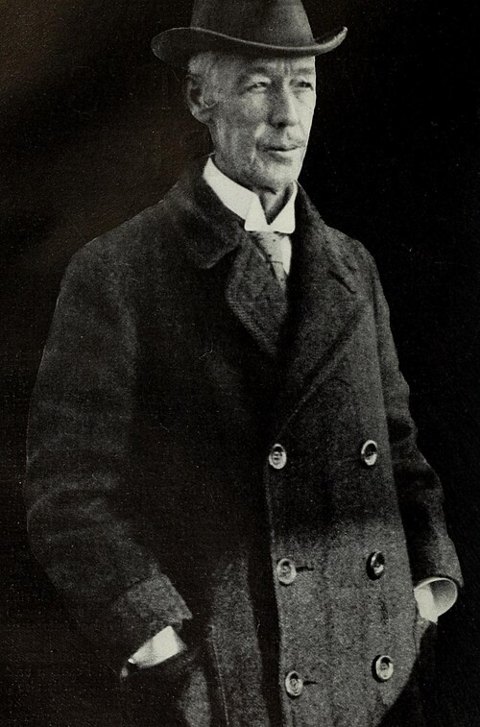
Sir William Willcocks (27 September 1852 in India – 28 July 1932 in Cairo, Egypt) was a British civil engineer during the high point of the British Empire. He was an irrigation engineer who proposed and built the first Aswan Dam, the scale of which had never been attempted previously. He later undertook other major irrigation projects in South Africa and the Ottoman Empire's Arabian territories.
Biography
Willcocks was born and baptised in Landour, British India, one of four sons of a British Engineer posted in Roorkee for Ganges canal works. He graduated from the Indian Institute of Technology Roorkee in 1872, and joined the Indian Public Works Department the same year. A few years later he married Susan Ann Scott Moncrieff, daughter of Rev. John Edward Scott Moncrieff, in Meerut, India. Following the British invasion and occupation of Egypt, he began work with the long-established Egyptian Public Works Department in 1883. He was serving as director general of reservoirs for Egypt when he completed his studies and plans in 1896 to construct the Aswan Low Dam, the first true storage reservoir on the river. He supervised its construction from 1898 to its completion in 1902. He also designed and constructed another dam on the Nile, the Assiut Barrage, also completed in 1902. For his service to these projects he was appointed a Knight Commander of the Order of St Michael and St George (KCMG) in December 1902. He later became chairman of the Cairo Water Works Company, and was also president of the Anglo-Egyptian Land Allotments Company which was instrumental for the urbanization of Zamalek district (then known as Gezireh) early in the 20th century. One of the streets of Zamalek was named 'Willcocks' after him. He left his position in Egypt by 1897 and four years later he was invited to South Africa. With the end of the Anglo-Boer War he was asked to look into the possibility of irrigation projects in the Transvaal and Orange River Colony.