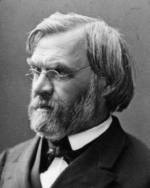
作者
Alexander Ecker
1816–1887
- 出生
- 1816年7月10日, 布赖斯高地区弗赖堡
- 逝世
- 1887年5月20日, 布赖斯高地区弗赖堡
- 国籍
- 德国
- 职业
- 人类学家, 大学教师, 解剖學家 和 生理学家
生平与作品
维基百科暂无该作者的中文条目。 以下为英语原文。
Johann Alexander Ecker (10 July 1816 – 20 May 1887) was a German anthropologist and anatomist, born in Freiburg im Breisgau. He was the son of Johann Matthias Alexander Ecker (1766–1829), a professor at the University of Freiburg.
Biography
He studied medicine at the University of Freiburg as a pupil of Karl Heinrich Baumgärtner. He received his medical doctorate at Freiburg in 1837. In 1840 he started work as a prosector at the University of Heidelberg, where during the following year, he became a privat-docent. At Heidelberg, his influences included Friedrich Tiedemann, Friedrich August Benjamin Puchelt, Theodor Ludwig Wilhelm Bischoff and Maximilian Joseph von Chelius. In 1844 he became a full professor at Basel, later returning to Freiburg as a professor of physiology and comparative anatomy (1850). In 1870 he was co-founder of the Akademische Gesellschaft.
As an anthropologist, Ecker conducted excavations of early burial sites in the Kaiserstuhl region of southwestern Germany. At the University of Freiburg, he created a museum of anthropology and ethnography (Museum für Urgeschichte und Ethnographie). With prehistorian Ludwig Lindenschmit the Elder (1809–1893), he founded the first German journal of anthropology, the Archiv für Anthropologie.
Ecker conducted anatomical studies of the brain, being known for his investigations of cerebral convolutions in the fetus. His name is associated with "Ecker's fissure", also known as the petro-occipital fissure.
He died in Freiburg im Breisgau.
In Freiburg, a thoroughfare known as the Eckerstraße was named in his honor until 2017, when it was renamed Ernst-Zermelo-Straße.
文字: “Alexander Ecker”, 来自自由的百科全书维基百科,许可协议为 CC BY-SA 4.0. 日期与资料:维基数据。
馆藏
Alexander Ecker的图书
1 图书