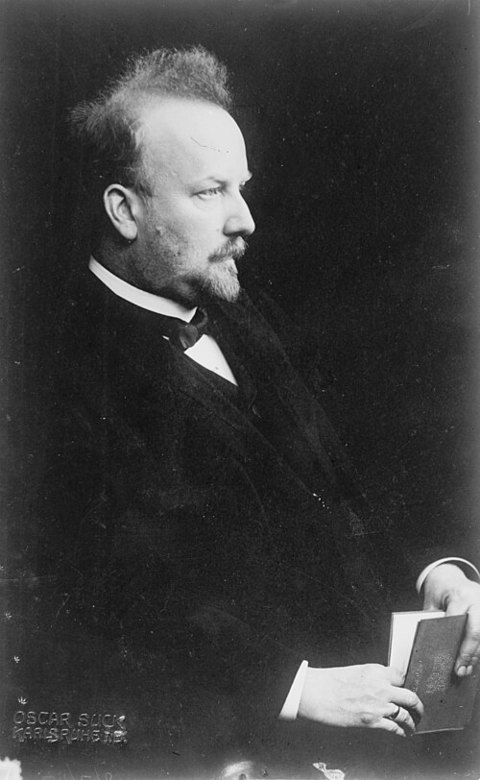
Christian Heinrich Arthur Drews (German: [dʁɛfs]; 1 November 1865 – 15 July 1935) was a German writer, historian, philosopher, and important representative of German monist thought. He was born in Uetersen, Holstein, in present-day Germany.
Biography
Drews became a professor of philosophy and German language at the Technische Hochschule in Karlsruhe. During his career he wrote widely on the histories of philosophy, religions and mythology. He was a disciple of Eduard von Hartmann who claimed that reality is the "unconscious World Spirit", also expressed in history through religions and the formation of consciousness in the minds of philosophers. Drews often provoked controversy, in part because of his unorthodox ideas on religion and in part because of his attacks on Nietzsche and passionate support of Wagner. He rose to international prominence with his book The Christ Myth (1909), by amplifying and publicizing the thesis initially advanced by Bruno Bauer, which denies the historicity of Jesus.
The international controversy provoked by the "Christ Myth" was an early part of Drews's lifelong advocacy of the abandonment of Judaism and Christianity, both of which he regarded as based on ancient beliefs from antiquity, and shaped by religious dualism. He urged a renewal of faith [Glaubenserneuerung] based on Monism and German idealism. He asserted that true religion could not be reduced to a cult of personality, even if based on the worship of the "unique and great personality" of a historical Jesus, as claimed by Protestant liberal theologians, which he argued was nothing more than the adaptation of the Great Man Theory of history promoted by Romanticism of the 19th century.