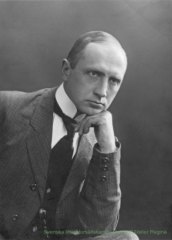
Arvid Mörne (6 May 1876 – 15 June 1946) was a Finland-Swedish author and poet. His nature poetry made the archipelago and coastal landscapes of Nyland the defining poetic landscape of Finland-Swedish literature. During the 1930s and 1940s he emerged as one of Scandinavia's foremost voices for democracy against the rising totalitarian movements in Europe, both as a poet and as a publicist. He was nominated for the Nobel Prize in Literature four times.
Biography
Mörne was born in Kuopio to Arvid Oscar Mörne and Maria Gustava Lindroos. He graduated in 1894 and obtained a master's degree in literature and history at the University of Helsinki in 1897, and a PhD in 1910. He worked as a superintendent at the Nyland's folk high school Finns between 1899 and 1909, and as a teacher at the same school between 1909 and 1911. He was forced to leave this position after his involvement in the General Strike of 1905, where led a deputation that entered the house of Governor-General Obolensky, where the Senate was assembled, and demanded its resignation.
He became a docent of Finnish literature at the University of Helsinki in 1913, a position he held until 1943. He worked at the newspapers Nyländska posten (1900–1902) and Veckans Nyheter (1902–1904) and also at Arbetaren and Helsingforsposten. He was also a literature critic for the newspapers Dagens Press and Svenska Pressen.
Throughout his early career, Mörne was drawn to three political movements: the Sweden-Finnish national movement, the social democratic labour movement, and the activist resistance party. He never formally joined any of them, holding that his commitment to the Swedish-speaking minority's cause was incompatible with membership in a socialist party, and vice versa.