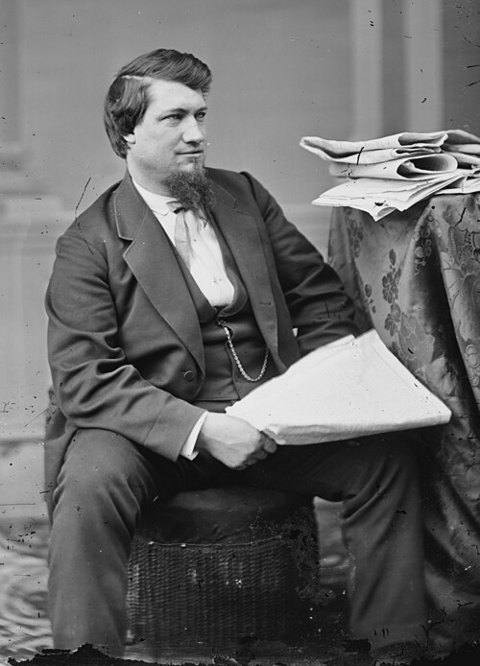
David Ross Locke (also known by his pseudonym Petroleum V. Nasby) (September 20, 1833 – February 15, 1888) was an American journalist and early political commentator during and after the American Civil War.
Early life
Locke was born in Vestal, New York, the son of Nathaniel Reed Locke and Hester Locke.
Career
He was apprenticed at age 12 to the Democrat in Cortland County, New York. Following a seven-year apprenticeship, he "tramped around" (meaning he was an itinerant printer) until a protracted stay with the Pittsburgh Chronicle. Around 1855, Locke started, with others, the Plymouth (Ohio) Herald.
On March 20, 1856, he became the editor of the Bucyrus Journal. By 1861, he had purchased and was the editor of The Jeffersonian in Findlay, Ohio, where he began writing his Nasby letters. From October 15, 1865, he edited and wrote for the Toledo Blade in Toledo, Ohio, which he purchased in 1867.
Nasby Letters
Locke's most famous works, the "Nasby Letters", were written in the character of, and over the signature of, "Rev. Petroleum V(esuvius) Nasby", a Copperhead and Democrat. Joseph Jay Jones described them as "the Civil War written in sulfuric acid."
Locke's fictional alter ego, Nasby, loudly champions the cause of the Confederate States of America from Secession onward, but does little to actively help it. After being conscripted into the Union Army he deserts to the Confederates, joining the fictional "Pelican Brigade". However, he finds life in the Confederate Army "tite nippin" and soon deserts again. By the end of the Civil War, he is back in civilian life.