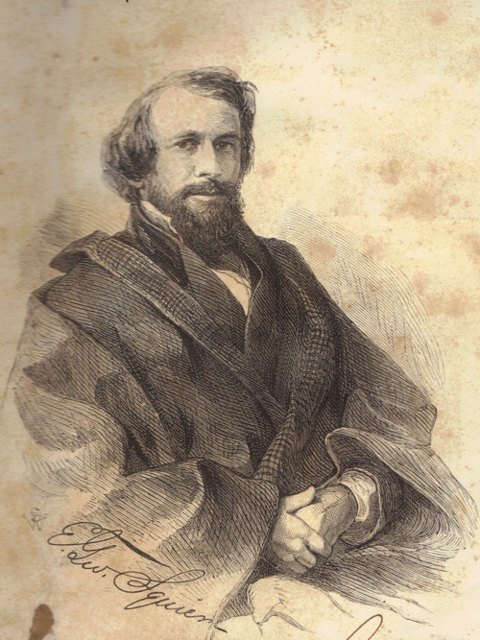
作者
E. G. Squier
1821–1888
- 出生
- 1821年6月17日, 伯利恒
- 逝世
- 1888年4月17日, 纽约
- 国籍
- 美国
- 职业
- 人类学家, 考古学家, 新闻工作者, 外交官 和 编辑
生平与作品
维基百科暂无该作者的中文条目。 以下为英语原文。
Ephraim George Squier (June 17, 1821 – April 17, 1888) was an American archaeologist, diplomat, and journalist. Born in Bethlehem, New York, he spent his early career in the northeastern United States. There, along with his colleague Edwin H. Davis, he was a prominent investigator of the prehistoric Indian mounds of the Ohio River valley. Squier received national recognition after he co-authored Ancient Monuments of the Mississippi Valley (1848). It was the first publication of the newly established Smithsonian Institution.
Squier's diplomatic career and archaeological fieldwork reflected his involvement in the geopolitical expansion of the United States. A proponent of American commercial interests, he also looked to Central America for interoceanic transit routes. Squier negotiated treaties in Nicaragua and Honduras, and his diplomatic efforts placed him in direct conflict with the British Empire. He began his professional practice as a newspaper editor and political organizer before developing his better-known career as an anthropologist and surveyor of Inca sites in Peru.
Later in his life, Squier's theoretical conclusions regarding a "lost race" of Mound Builders fell out of favor. Following a severe mental breakdown and the end of his marriage to Miriam Florence Folline, he moved out of his active professional life and into a private asylum, eventually living quietly in Brooklyn. Squier was a founding member and the first president of the Anthropological Institute of New-York. His empirical surveying methods established early standards for American archaeology, and his collections are held by institutions like the American Museum of Natural History and the Peabody Museum of Archaeology and Ethnology.
文字: “E. G. Squier”, 来自自由的百科全书维基百科,许可协议为 CC BY-SA 4.0. 日期与资料:维基数据。