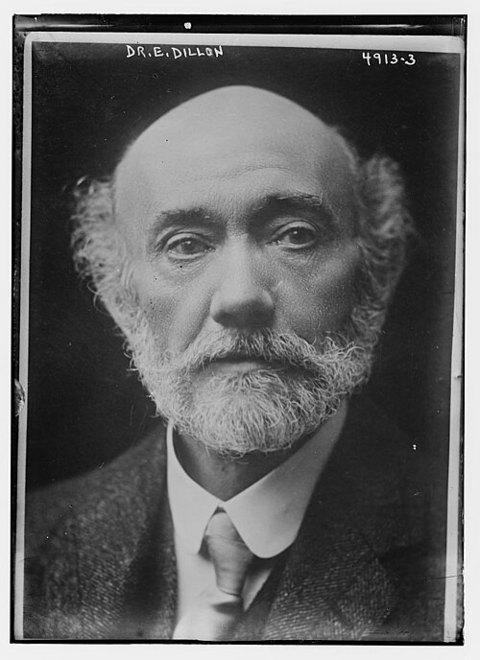
Emile Joseph Dillon (21 March 1854 – 9 June 1933) was an Irish author, journalist and linguist.
Biography
He was born on 21 March 1854 in Dublin, Ireland, the son of an Irish father and an English mother.
Dillon initially trained for the priesthood; however, he abandoned all plans for a career in the church when he was 21, and immersed himself in the study of Oriental languages at the Collège de France in Paris. He later was awarded the degree of Doctor of Philosophy by the University of Leipzig, and obtained two further doctorates, in Oriental Languages and Literature from the Catholic University of Leuven, and in Comparative Philology from the University of Kharkiv.
He was Russian correspondent of The Daily Telegraph from 1887 to 1914 and, for a short time, was professor of Sanskrit, Classical Armenian, and Comparative Philology at the University of Kharkiv. He was a friend and associate of the Russian statesman Sergei Witte, whom he accompanied in 1905 to the peace conference at Portsmouth, New Hampshire which formally brought to an end the Russo-Japanese War. He also reported the Dreyfus trial of 1899, the Boxer Rebellion in 1900, and the Versailles peace conference in 1919. When working as a journalist, Dillon occasionally disguised himself in order to observe the action from closer quarters, as was the case when he was sent by The Daily Telegraph to report on the Turkish massacres of Armenians in 1894–1895.
He sometimes used the pseudonym E.B.Lanin, probably indicating "Dubliner"- Eblana is the Latin for Dublin and the ending "-in" is a nominal ending as in Lenin, Stalin etc.