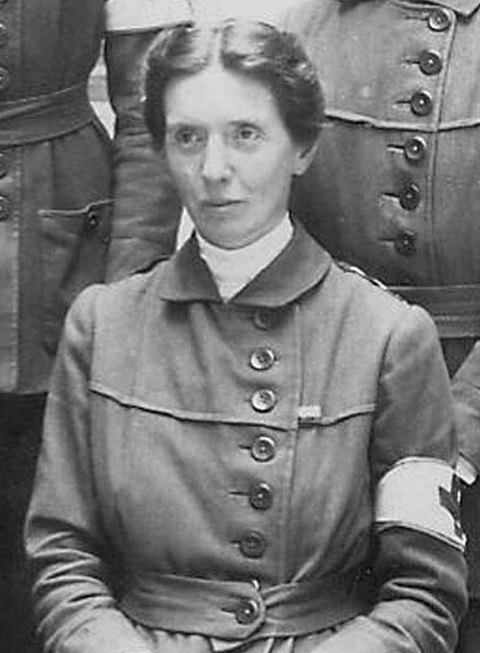
作者
Flora Murray
1869–1923
- 出生
- 1869年5月8日, 邓弗里斯
- 逝世
- 1923年7月28日, 汉普斯特得
- 国籍
- 大不列颠及爱尔兰联合王国
- 职业
- 医生 和 妇女参政论者
生平与作品
维基百科暂无该作者的中文条目。 以下为英语原文。
Flora Murray (8 May 1869 – 28 July 1923) was a Scottish medical pioneer, and a member of the Women's Social and Political Union suffragettes. From 1914 to the end of her life, she lived with her partner and fellow doctor Louisa Garrett Anderson.
Early life and education
Murray was born on 8 May 1869 at Murraythwaite, Dumfries, Scotland, the daughter of Grace Harriet Murray (née Graham) and John Murray, a landowner and Royal Navy captain. Murray was the fourth of six children.
Murray attended school in Germany and London before attending the London Hospital in Whitechapel in 1890, as a probationer nurse, for a six-month course. Murray decided on her career in medicine and went on to study in the London School of Medicine for Women in 1897. She then worked as a Medical assistant for 18 months at an asylum at the Crichton Royal Institution in Dumfriesshire. This experience was crucial in her writing of her MD thesis called 'Asylum Organization and Management' (1905). She completed her medical education at Durham University, receiving her MB BSc in 1903, and MD in 1905. She received a Diploma in Public Health from the University of Cambridge in 1906.
During her time in Scotland, Murray lived in Edinburgh with Dr Elsie Inglis, founder of the Scottish Women's Hospitals movement. Historians such as Hamer and Jennings have argued that Murray had her "first serious lesbian relationship" with Elsie Inglis.
Physician
In 1905 Murray was a medical officer at the Belgrave Hospital for Children in London and then an anaesthetist at the Chelsea Hospital for Women. In 1905 The Lancet published an article that she authored on the use of anaesthetic in children, titled Ethyl chloride as an anaesthetic for children.
文字: “Flora Murray”, 来自自由的百科全书维基百科,许可协议为 CC BY-SA 4.0. 日期与资料:维基数据。
馆藏
Flora Murray的图书
1 图书