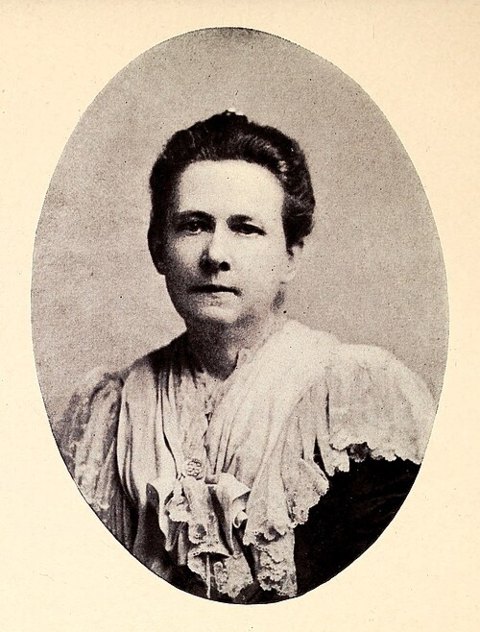
Florence Marion Howe Hall (August 25, 1845 – April 10, 1922) was an American writer, critic, and lecturer about women's suffrage in the United States. Along with her two sisters, Laura Elizabeth Richards and Maude Howe Elliott, Hall received the first Pulitzer Prize for a biography, Julia Ward Howe.
Early life
Howe was born on August 25, 1845, in South Boston, Massachusetts. She was named Florence after Florence Nightingale, her godmother and friend of her parents, and Marion after her great—great-granduncle, General Francis Marion of the Revolutionary War fame. Florence was the second of six children born of the marriage of Dr. Samuel Gridley Howe, a prominent physician, abolitionist and founder of the Perkins Institution and Massachusetts School for the Blind, and Julia Ward Howe, a poet and author, best known for writing "The Battle Hymn of the Republic". Her elder sister was Julia Romana Howe; and her younger siblings included Henry Marion Howe, a metallurgist; Laura (née Howe) Richards and Maud (née Howe) Elliott, both authors; Her younger sister Maud married John Elliott, an English muralist and illustrator.
She was educated at private schools in Boston and nearby, including the Agassiz School of Cambridge. She later studied music with Otto Dresel, the pianist, music teacher and composer.
Career
She was a writer, critic, and lecturer about women's suffrage in the United States, serving as president of the New Jersey State Woman Suffrage Association from 1893 to 1900.
Hall began her writing career with children's stories, but quickly moved on to memoirs and etiquette books.