作者
Frederic George Stephens
1827–1907
- 出生
- 1827年10月10日, 伦敦
- 逝世
- 1907年3月9日, 伦敦
- 国籍
- 大不列颠及爱尔兰联合王国
- 职业
- 画家, 文学评论家, 美术史学家 和 艺术评论家
生平与作品
维基百科暂无该作者的中文条目。 以下为英语原文。
Frederic George Stephens (10 October 1827 – 9 March 1907) was a British art critic, and one of the two 'non-artistic' members of the Pre-Raphaelite Brotherhood.
Life
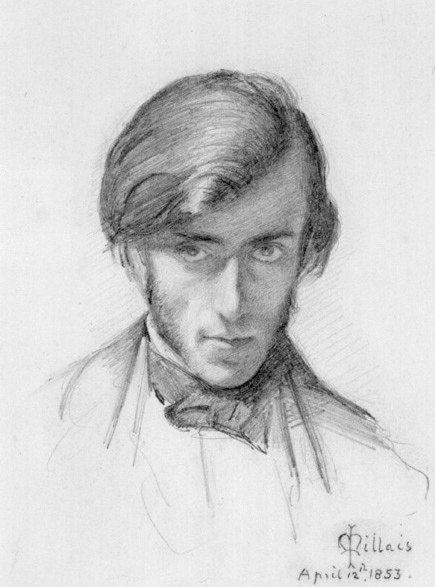
Stephens was born to Septimus Stephens of Aberdeen and Ann (née Cook) in Walworth, London and grew up in nearby Lambeth. Because of an accident in 1837, he was physically disabled and was educated privately. He later attended University College School, London. In 1844 he entered the Royal Academy Schools where he first met John Everett Millais and William Holman Hunt. He joined their Pre-Raphaelite Brotherhood in 1848, often modelling for them in pictures including Millais's Ferdinand Lured by Ariel (1849) and Ford Madox Brown's Jesus Washing Peter's Feet (1852–1856; Tate, London). There is a pencil portrait of Stephens by Millais dated 1853 in the collection of the National Portrait Gallery.
Stephens was so disappointed by his own artistic talent that he took up art criticism and stopped painting. In later life he claimed to have destroyed all his paintings, but three of them are now in the Tate Gallery, London: The Proposal (The Marquis and Griselda) (1850–51), Morte d'Arthur (1849), and Mother and Child (circa 1854–1856), along with a pencil drawing of his stepmother Dorothy (1850), a study for an oil portrait he exhibited at the Royal Academy in 1852. He also exhibited a portrait of his father (1852–53) at the Academy in 1854. A large pen-and-ink drawing illustrating a subject from Geoffrey Chaucer's The Pardoner's Tale, Dethe and the Riotours (1848–1854), which he gave to Dante Gabriel Rossetti in 1854, is now in the Ashmolean Museum, Oxford.
文字: “Frederic George Stephens”, 来自自由的百科全书维基百科,许可协议为 CC BY-SA 4.0. 日期与资料:维基数据。
馆藏
Frederic George Stephens的图书
2 图书