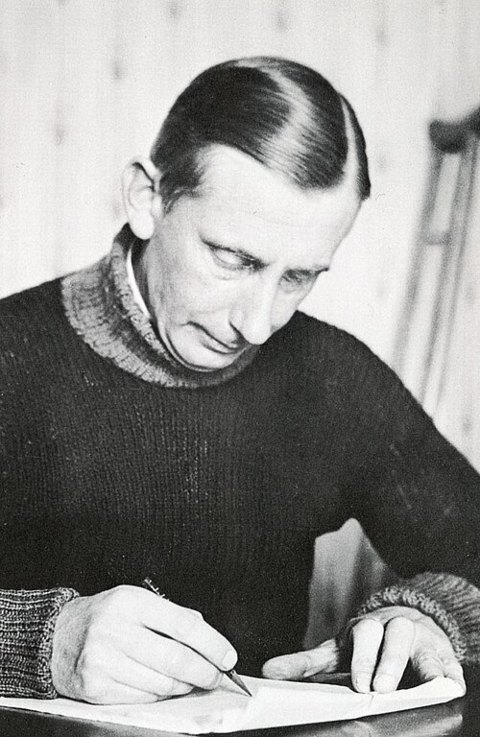
Frederick Philip Grove (February 14, 1879 – September 9, 1948) was a German-born Canadian novelist and translator.
He was a prolific translator in Germany, working under his original name Felix Paul Greve and posing as a dandy, before he left Berlin to start a new life in North America in late July 1909. Settling in Manitoba, Canada, in 1912, he became a well known Canadian fiction writer exploring Western prairie pioneer life in vibrant multi-cultural communities. A bigamist, Grove constructed his entire life as an intricate web of fact and fiction. He died in 1948 on his estate in Simcoe, Ontario, where he had resided since 1930.
Early life in Europe
Grove was born Felix Paul Greve in Radomno, West Prussia, but was brought up in Hamburg where he graduated with the Abitur from the Gymnasium Johanneum in 1898. After studying classical languages and archaeology in Bonn, he became a prolific translator of world literature and a member of Stefan George's homoerotic group, the George-Kreis, around 1900. During his year in Munich, he befriended Karl Wolfskehl, and briefly shared an address with Thomas Mann at the Pension Gisels from August to September 1902. In early 1903, amidst scandal, he settled in Palermo, Italy, with Else Plötz Endell, the wife of renowned architect August Endell (she would later become Baroness Elsa von Freytag-Loringhoven). In his 1946 autobiography In Search of Myself, Grove suggests that despite the homoerotic context of his work up to late 1902, his first sexual encounter with Elsa determined his sexuality: "If I had not always been so, I had become definitely, finally heterosexual."