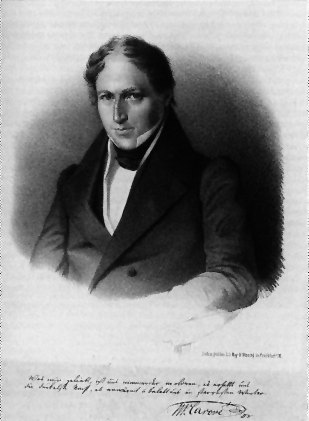
作者
Friedrich Wilhelm Carové
1789–1852
- 出生
- 1789年6月20日, 科布伦茨
- 逝世
- 1852年3月18日, 海德堡
- 国籍
- 普鲁士王国
- 职业
- 法学家, 哲学家, 律师, 作家 和 政治人物
生平与作品
维基百科暂无该作者的中文条目。 以下为英语原文。
Friedrich Wilhelm Carové (June 20, 1789 – March 18, 1852) was a German philosopher and publicist.
Biography
He was a lawyer, held some judicial offices, was made doctor of philosophy by the University of Heidelberg, and officiated for a short time as professor at Breslau. He was one of the founders of the Heidelberg Burschenschaft, and participated in the famous Wartburg festival. He was afterward a member of the provisional German parliament (German: Frankfurter Vorparlament) of 1848.
Carové was a pupil of Hegel's between 1816 and 1818 and was chosen by Hegel as the first interpreter of his thought. They were in friendly terms for all their life. Due to his publication of a booklet on the Sand Affair in 1819, he was investigated by the police and arrested, thus excluded from the post in Berlin University. He was harassed and put under surveillance by Prince Sayn-Wittgenstein and his reactionary circles in the Prussian court. Carové's career was thus destroyed despite Hegel's best efforts to help him.
In 2022 over 4000 pages of his notes and transcriptions of Hegel's lectures were found by Klaus Vieweg in the library of Roman Catholic Archdiocese of Munich and Freising. The manuscripts were believed to be a gift sent by Carové to Karl Joseph Hieronymus Windischmann, a friend of Hegel's, as a gift.
文字: “Friedrich Wilhelm Carové”, 来自自由的百科全书维基百科,许可协议为 CC BY-SA 4.0. 日期与资料:维基数据。
馆藏
Friedrich Wilhelm Carové的图书
1 图书