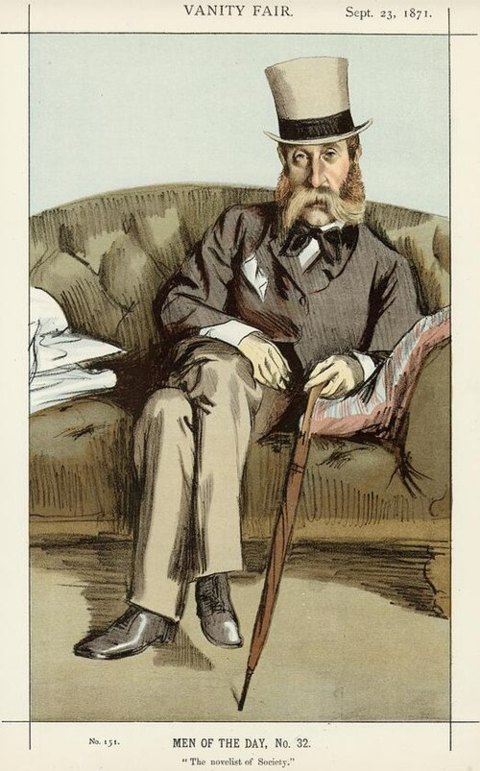
George John Whyte-Melville (19 June 1821 – 5 December 1878) was a Scottish novelist much concerned with field sports, and also a poet. He took a break in the mid-1850s to serve as an officer of Turkish irregular cavalry in the Crimean War.
Life and work
George John Whyte-Melville was born in 1821, at Mount Melville near St Andrews, Scotland, as a son of Major John Whyte-Melville and Lady Catherine Anne Sarah Osborne and a grandson on his mother's side of the 5th Duke of Leeds. His father was a well-known sportsman and Captain of The Royal and Ancient Golf Club of St Andrews.
George was tutored privately at home by the young Robert Lee, then educated at Eton, before entering the army with a commission in the 93rd Highlanders in 1839. He exchanged into the Coldstream Guards in 1846, and retired with the rank of captain in 1849.
Whyte-Melville married the Hon. Charlotte Hanbury-Bateman in 1847, and they had one daughter, Florence Elizabeth, who went on to marry Clotworthy Skeffington, 11th Viscount Massereene. His marriage was not a happy one, and this led to the "constantly recurring note of melancholy" that runs through all of his novels, "especially in reference to women". His wife also was not happy with the marriage.
In 1849 Whyte-Melville was the subject of a summons for maintenance by Elizabeth Gibbs, described as "a smartly-dressed and interesting looking young woman", who alleged that he was the father of her son. She stated that she had known Whyte-Melville since December 1846 and that she had given birth to his child on 15 September 1847. The Magistrate read some letters stated by Gibbs to be from Whyte-Melville, in one of which the writer expressed his wish that Gibbs would fix the paternity unto some other person as he did not wish to pay for the pleasure of others. The Magistrate found for the defendant as the written evidence could not be proved to be in Whyte-Melville's hand, but allowed the complainant to apply for a further summons in order to obtain proof. Gibbs testified that since the child was born, she had received £10 from Whyte-Melville, and he had offered her two sums of £5, on condition that she surrender his letters to her, and sign a disclaimer on further claims. The case continued on 25 September 1849. Gibbs' landlady, supported by her servant, testified that Gibbs was in the habit at the time of receiving visits from other gentlemen, particularly two, one of whom had paid for the nurse and supported Gibbs during her confinement. The magistrate said that there had definitely been perjury on one side or the other and dismissed the summons.