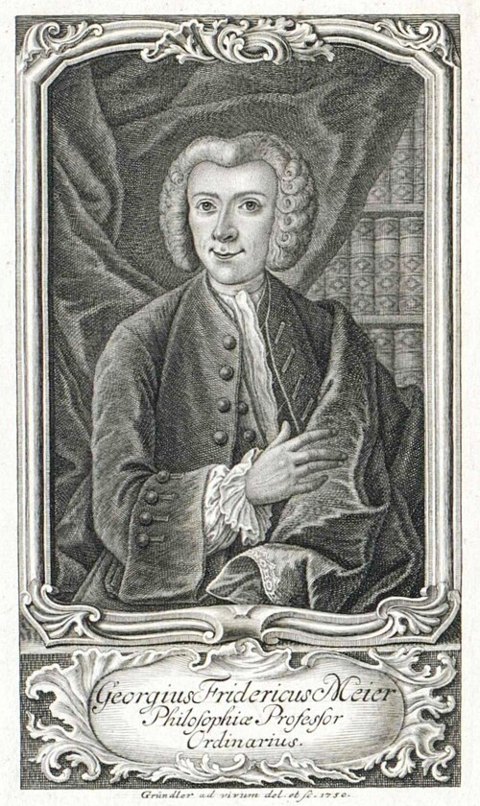
作者
Georg Friedrich Meier
1718–1777
- 出生
- 1718年3月26日, 阿门多夫
- 逝世
- 1777年6月21日, Giebichenstein
- 国籍
- 德国
- 职业
- 哲学家, 大学教师 和 数学家
生平与作品
维基百科暂无该作者的中文条目。 以下为英语原文。
Georg Friedrich Meier (26 March 1718 – 21 June 1777) was a German philosopher and aesthetician. A follower of Alexander Gottlieb Baumgarten, he reformed the philosophy of Christian Wolff by introducing elements of John Locke's empiricist theory of knowledge.
Career
Meier studied philosophy and theology at the University of Halle, where he was a pupil of Baumgarten. Meier succeeded Baumgarten as extraordinary professor, and became a full professor at Halle in 1748.
Animal rights
Meier was an early advocate of animal rights. In 1749, Meier authored Versuch eines neuen Lehrgebäudes von den Seelen der Thiere (Attempt of a new teaching structure from the souls of animals) which ascribed the same sensory perceptions to both animals and man. He granted animals imagination, intelligence, judgement, memory, language, pleasure and displeasure. Meier believed that animals were capable of love and that their souls were eternal for God cannot destroy anything.
Meier fiercely opposed the mechanist views of René Descartes. He believed that God had endowed animals with souls to enjoy his creation and after death an animals soul could reach the next step of incarnation until finally becoming a human soul. His doctrine of metempsychosis was not based on respect for animal life or their welfare. In contrast, Meier advocated the killing of animals due to his unusual belief that it would accelerate the rise of their souls.
文字: “Georg Friedrich Meier”, 来自自由的百科全书维基百科,许可协议为 CC BY-SA 4.0. 日期与资料:维基数据。
馆藏
Georg Friedrich Meier的图书
1 图书