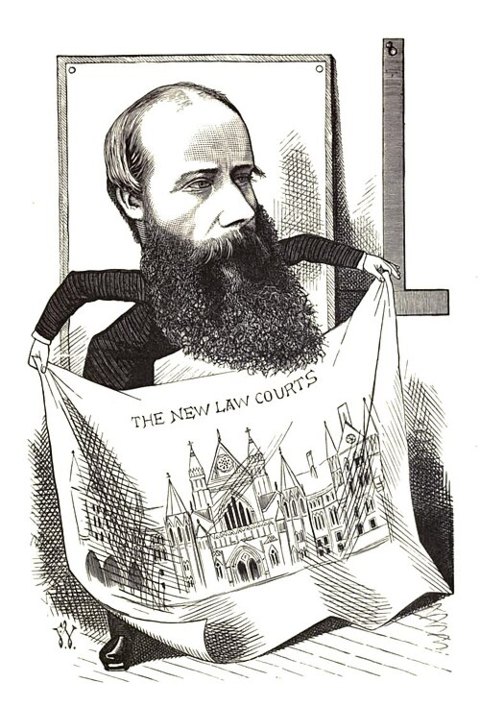
作者
George Edmund Street
1824–1881
- 出生
- 1824年6月20日, Woodford
- 逝世
- 1881年12月18日, 伦敦
- 国籍
- 大不列颠及爱尔兰联合王国
- 职业
- 建筑师 和 美术史学家
- 代表作品
- Church of St. Margaret of Antioch, Liverpool · Church of the Resurrection and All Saints, Caldy · St Mary's Church, Southampton · 皮姆利科小圣雅各堂
生平与作品
维基百科暂无该作者的中文条目。 以下为英语原文。
George Edmund Street (20 June 1824 – 18 December 1881), also known as G. E. Street, was an English architect, born at Woodford in Essex. Stylistically, Street was a leading practitioner of the Victorian Gothic Revival. Though mainly an ecclesiastical architect, he is perhaps best known as the designer of the Royal Courts of Justice on the Strand in London.
Early life
Street was the third son of Thomas Street, a solicitor, by his second wife, Mary Anne Millington. He went to school at Mitcham in about 1830, and later to the Camberwell Collegiate School, which he left in 1839. For a few months he worked in his father's business in Philpot Lane, but on his father's death he went to live with his mother and sister at Exeter. There his thoughts first turned to architecture, and in 1841 his mother obtained a place for him as a pupil in the office of Owen Browne Carter at Winchester. Afterwards he worked for five years as an "improver" with George Gilbert Scott in London.
Street's first commission – undertaken while still working for Scott – was for the design of Biscovey church in Cornwall. In 1849 he set up in practice in an office of his own. Much of his earliest work, which included many church restorations, was in Cornwall.
Career
In November 1850, having been appointed architect to the diocese of Oxford by Bishop Samuel Wilberforce, he left London, and moved to Wantage, where he had already designed a vicarage, and was working on some schools. In May 1852 he went to live in Beaumont Street, Oxford. He designed the parish church of SS Philip and James in the city, and another at Summertown, as well as restoring many others. Street built or restored 113 churches in the diocese of Oxford. However, his only work for the university was the reordering of Jesus College Chapel. His son Arthur Edmund Street suggested that: Possibly my father's very decided adherence to the earlier phase of Gothic, and the eagerness with which he argued that Oxford already had enough of debased types, and should revert to the purity of the early forms, may have frightened the authorities.During this period he developed his use of constructional polychromy, in churches such as All Saints, Boyne Hill. Maidenhead.
文字: “George Edmund Street”, 来自自由的百科全书维基百科,许可协议为 CC BY-SA 4.0. 日期与资料:维基数据。
馆藏
George Edmund Street的图书
3 图书