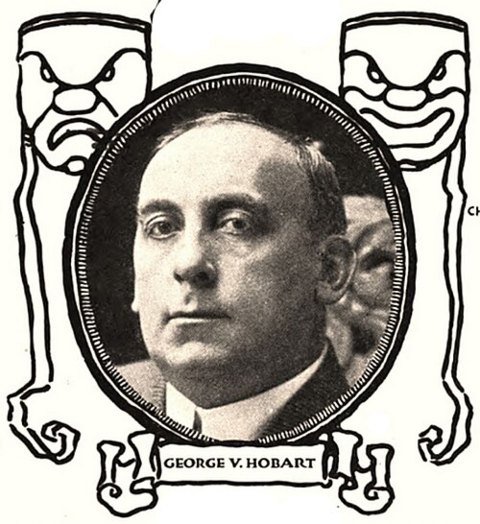
George Vere Hobart (1867–1926) was a Canadian-American humorist who authored more than 50 musical comedy librettos and plays as well as novels and songs. At the time of his death, Hobart was "one of America's most popular humorists and playwrights". Hobart gained initial national fame for the "Dinkelspiel" letters, a weekly satirical column written in a German-American dialect. The Library of Congress includes several of his songs in the National Jukebox.
Hobart also wrote under the pseudonym Hugh McHugh. Many of his works were adapted into films.
Early life
Hobart was born 16 January 1867 in Cape Breton, Nova Scotia, Canada. He immigrated to the Cumberland, Maryland to work as a telegraph operator for the United Press.
Career
Hobart wrote humorous sketches and columns for the Sunday Scimitar and Baltimore News-American newspapers. He then worked for a short time at the New York Journal, before turning his attention to writing musicals, librettos, novels and children's books. Hobart is noted as an "exceptionally prolific" and versatile writer.
His better-known stage plays include the morality tale Experience; Our Mrs. McChesney cowritten with Edna Ferber and starring Ethel Barrymore; Miss Prinnt with Marie Dressler; Sonny; Hitchy-Koo of 1919 with music by Cole Porter; Buddies, and Sweet Sixteen.
Among Hobart's notable books are John Henry, Down the Line, Back to the Woods, You Can Search Me and the 1904 novel Jim Hickey, A Story of the One-Night Stands. The Random House Dictionery of American slang cites ' Hickey ' as the first time the word ' Hip ', in the slang sense of being " aware, in the know", in a cartoon by Tad Dorgan, where an African-American character uses the slang phrase "Are you hip?".