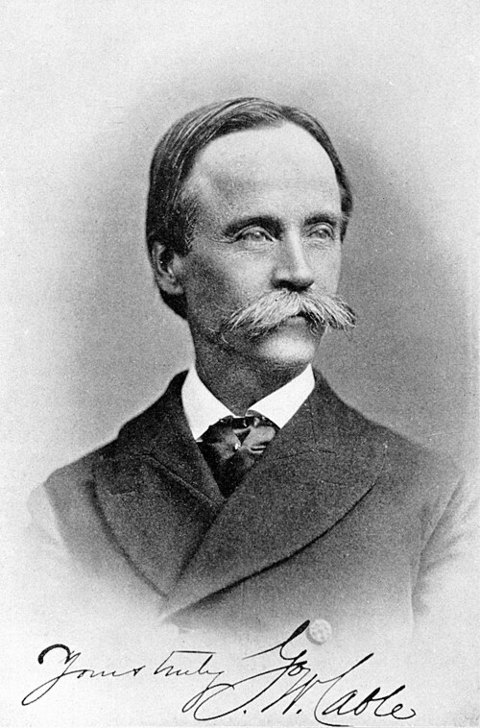
George Washington Cable (October 12, 1844 – January 31, 1925) was an American novelist notable for the realism of his portrayals of Creole life in his native New Orleans, Louisiana. He has been called "the most important southern artist working in the late 19th century", as well as "the first modern Southern writer". In his treatment of racism, mixed-race families, and miscegenation, his fiction has been thought to anticipate that of William Faulkner.
He also wrote articles critical of contemporary society. Due to hostility against him after two 1885 essays encouraging racial equality and opposing Jim Crow, Cable moved with his family to Northampton, Massachusetts. He lived there for the next thirty years, then moved to Florida.
Early life
George Washington Cable was born in 1844 in New Orleans, Louisiana, to George W. Cable Sr., and Rebecca Boardman Cable. His parents were wealthy slaveholders and members of the Presbyterian Church and of New Orleans society, whose families had moved there after the Louisiana Purchase. First educated in private schools, the younger Cable had to work after his father died young: the elder Cable had lost investments, and the family struggled financially. Young Cable later learned French on his own. Supporting the Confederacy during the American Civil War, he served in the Confederate States Army, enlisting in the 4th Mississippi Cavalry Regiment in October 1863 at age 19.
Career
Cable's experiences changed his ideas about Southern and Louisianan society, and he began writing during a two-year bout with malaria. In 1870, he became a journalist, writing for the New Orleans Picayune. He worked for the newspaper from 1865 to 1879, by which time he had become an established writer. In 1869, George Cable married Louisa Stewart Bartlett, with whom he had several children.