Sir Harry Lauder (4 August 1870 – 26 February 1950) was a Scottish singer, comedian and actor. Popular in both music hall and vaudeville theatre traditions; he achieved international success.
He was described by Sir Winston Churchill as "Scotland's greatest ever ambassador", who "by his inspiring songs and valiant life, rendered measureless service to the Scottish race and to the British Empire". He became a familiar worldwide figure deploying his kilt and cromach (walking stick) as icons of Scottishness to huge acclaim, especially in America. Among his most popular songs were "Roamin' in the Gloamin'", "A Wee Deoch-an-Doris", "The End of the Road" and, a particularly big hit for him, "I Love a Lassie".
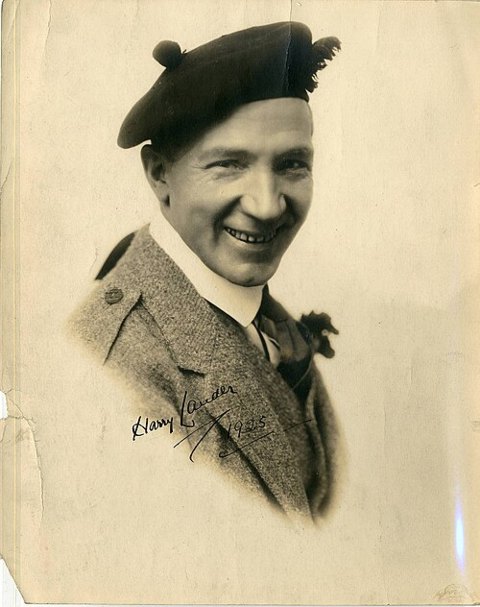
Lauder's understanding of life, its pathos and joys, earned him his popularity. Beniamino Gigli commended his singing voice and clarity. Lauder usually performed in full Highland regalia—kilt, sporran, tam o' shanter, and twisted walking stick, and sang Scottish-themed songs. By 1911 Lauder had become the highest-paid performer in the world, and was the first artist from both Britain and Scotland to sell a million records; by 1928 he had sold double that. He raised vast amounts of money for the war effort during the First World War, for which he was knighted by George V in 1919. He went into semi-retirement in the mid-1930s, but briefly emerged to entertain troops in the Second World War. By the late 1940s he was suffering from long periods of ill-health; he died in his native Scotland in 1950.