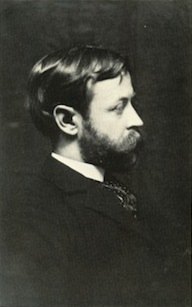
Henry Blake Fuller (January 9, 1857 – July 28, 1929) was an American novelist and short story writer. He was born and worked in Chicago, Illinois. He is perhaps the earliest novelist from Chicago to gain a national reputation. His exploration of city life was seen as revelatory, and later in his life he was perhaps the earliest established American author to explore homosexuality in fiction.
Career
Fuller's earliest works were travel romances set in Italy that featured allegorical characters. Both The Chevalier of Pensieri–Vani (1890) and The Châtelaine of La Trinité (1892) bear some thematic resemblance to the works of Henry James, whose primary interest was in the contrast between American and European ways of life. Fuller's first two books appealed to the genteel tastes of cultivated New Englanders such as Charles Eliot Norton and James Russell Lowell, who took Fuller's work as a promising sign of a burgeoning literary culture in what was then still largely the frontier city of Chicago.
Fuller then turned to literary realism, writing The Cliff-Dwellers (1893), what is perhaps the first novel set among the skyscrapers and frenetic business culture of modern-day Chicago. The novel shocked and outraged Chicago readers, who found its unflattering portrait of the city jarring. The novel won the praise of the influential critic and novelist William Dean Howells, whose positive review did much to secure Fuller's position as an important regional realist. Novels like The Cliff-Dwellers and With the Procession (1895) were influenced by the social realism of Howells, who described American institutions being transformed by the economic and demographic changes of the late nineteenth century, although the scenes of violence in The Cliff-Dwellers feature elements of naturalism not to be found in Howells' novels. With the Procession, though realistic, was kindlier in touch, with humor playing over its seriousness, unlike the relentless realism of The Cliff-Dwellers. Fuller's preference for Howells over James is the subject of one of Fuller's important unpublished essays entitled "Howells or James?"