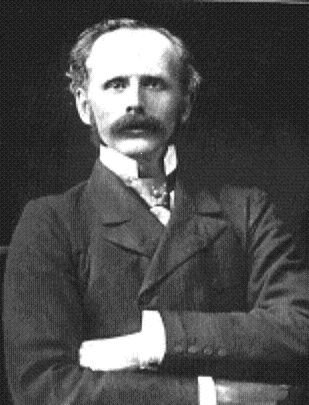
Henry Drummond FRSE FGS (17 August 1851 – 11 March 1897) was a Scottish evangelist, biologist, writer and lecturer.
Many of his writings were too adapted to the needs of his own day to justify the expectation that they would long survive it. His sermon "The Greatest Thing in the World" remains popular in Christian circles.
Early life
Drummond was born at Park Place in Stirling, his father Henry Drummond (1809-1888) and his mother, Jane Campbell Blackwood (d.1910) Henry being the grandson of William Drummond (d.1888) a seedsman and founder of Drummond Seeds. His early education was at Stirling High School and Morrison's Academy.
Drummond was educated at Edinburgh University, where he displayed a strong inclination for physical and mathematical science. The religious element was an even more powerful factor in his nature, and he entered the Free Church of Scotland. While preparing for the ministry, he became for a time deeply interested in the evangelizing mission of D.L. Moody and I.D. Sankey, where he was active for two years. Theologically, Drummond was significantly influenced by the Reveil movement in Reformed Protestantism.
Career
In 1877 he was lecturer on natural science in the Free Church College on Lynedoch Street in Glasgow, which enabled him to combine all the pursuits for which he felt a vocation. Drummond advocated for theistic evolution. His studies resulted in his writing Natural Law in the Spiritual World, the argument being that the scientific principle of continuity extends from the physical world to the spiritual. Before the book was published in 1883, an invitation from the African Lakes Company took Drummond to Central Africa.