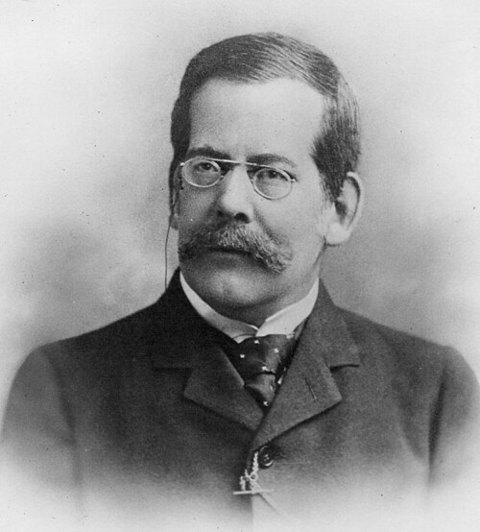
Henry Sweet (15 September 1845 – 30 April 1912) was an English philologist, phonetician and grammarian.
As a philologist, he specialized in the Germanic languages, particularly Old English and Old Norse. In addition, Sweet published works on larger issues of phonetics and grammar in language and the teaching of languages. Many of his ideas have remained influential, and a number of his works continue to be in print, being used as course texts at colleges and universities.
Life and work
Henry Sweet was born in St Pancras, London. He was educated at Bruce Castle School and King's College School, London. In 1864, he spent a short time studying at Heidelberg University. Upon his return to England, he took up an office job with a trading company in London. Five years later, aged twenty-four, he won a scholarship in German and entered Balliol College in Oxford.
Sweet neglected his formal academic coursework, concentrating instead on pursuing excellence in his private studies. Early recognition came in his first year at Oxford, when the prestigious Philological Society (of which he was later to become president) published a paper of his on Old English. In 1871, still an undergraduate, he edited King Alfred's translation of the Cura Pastoralis for the Early English Text Society (King Alfred's West-Saxon Version of Gregory's Pastoral Care: With an English Translation, the Latin Text, Notes, and an Introduction), his commentary establishing the foundation for Old English dialectology. He graduated in 1873, nearly thirty years old, with a fourth-class degree in literae humaniores. Subsequent works on Old English included An Anglo-Saxon Reader (1876), The Oldest English Texts (1885) and A Student's Dictionary of Anglo-Saxon (1896).