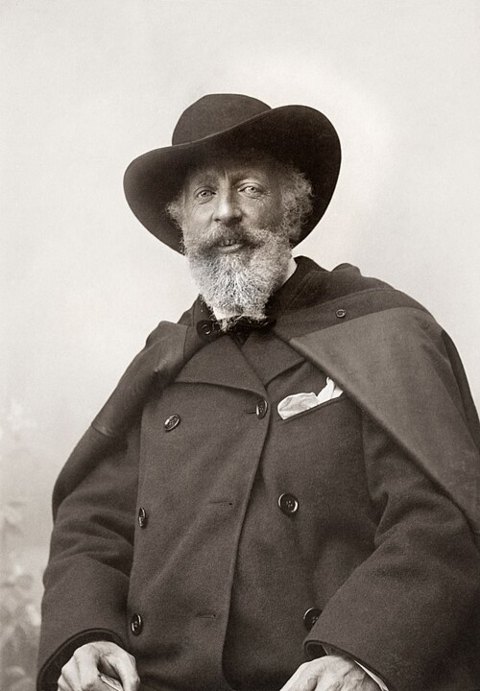
Holger Henrik Herholdt Drachmann (9 October 1846 – 14 January 1908) was a Danish poet, dramatist and painter. He was a member of the Skagen artistic colony and became a figure of the Scandinavian Modern Breakthrough Movement.
Early years
Drachmann was born in Copenhagen, Denmark. He was the son of Andreas Georg Drachmann (1810–1892) and Wilhelmine Marie Stæhr (1820–1857). His father was a surgeon with the Royal Danish Navy. The family belonged to the German-speaking congregation at St. Peter's Church (Sankt Petri Kirke) in Copenhagen.
Owing to the early death of his mother, he was left much to his own devices and developed a fondness for semi-poetical performances, organising his companions in heroic games, in which he himself took such roles as those of Royal Danish Naval heroes Peder Tordenskjold and Niels Juel.
Skagen
Drachmann first visited Skagen in 1872 with the Norwegian painter Frits Thaulow. He frequently returned, associating with the growing colony of artists known as the Skagen Painters (Skagensmalerne) although his painting took second place to his writing. In 1903, he and his third wife Soffi settled in Skagen's Vesterby in their Villa Pax. Later in life, Drachmann returned to art, often painting pictures of ships and the sea.
Personal life
Holger was sent to Bornholm to learn to paint. There he met his first wife Vilhelmine Erichsen (1852–1935), whom he married in 1871 in Gentofte. They had one daughter, Eva. In 1874, his marriage ended. He was then involved with a married woman named Polly for a short while. Shortly after she gave birth to a daughter, she broke contact with him. He then met with a young girl in Hamburg by the name of Emmy. They fell in love and got married. They adopted Polly's daughter and had four more children of their own. In 1887, she became seriously ill, and one of their daughters died the same year. Perhaps suffering from stress, he fled into a relation with cabaret singer Amanda Nielsen (1866–1953), whom he called Edith and who became his biggest muse. He would have many muses in his life, but on his deathbed he said that his two biggest muses were Vilhelmine and Edith. He died in Copenhagen and is buried in the sand dunes at Grenen, near Skagen. After his death his Skagen home, Drachmanns Hus, became a museum.