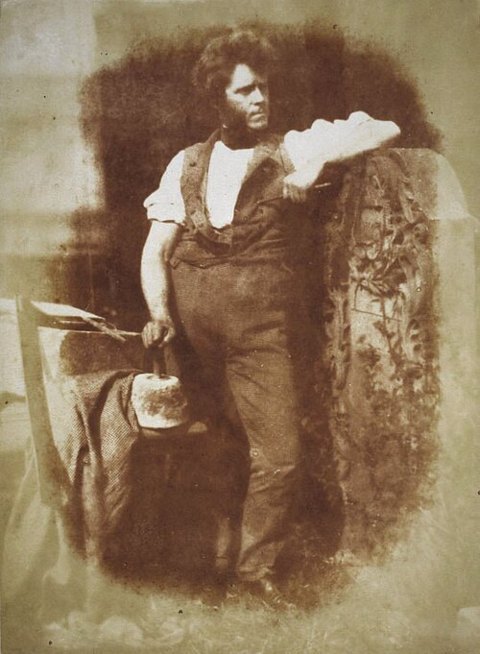
Hugh Miller (10 October 1802 – 24 December 1856) was a Scottish geologist, writer and folklorist.
Life and work
Miller was born in Cromarty, the first of three children of Harriet Wright (bap. 1780, d. 1863) and Hugh Miller (bap. 1754, d. 1807), a shipmaster in the coasting trade. Both parents were from trading and artisan families in Cromarty. His father died in a shipwreck in 1807, and he was brought up by his mother and uncles. He was educated in a parish school where he reportedly showed a love of reading. It was at this school that Miller was involved in an altercation with an Afro-Caribbean classmate in which he stabbed his thigh. Miller was subsequently expelled from the school following an unrelated incident. At 17 he was apprenticed to a stonemason, and his work in quarries, together with walks along the local shoreline, led him to the study of geology. In 1829 he published a volume of poems, and soon afterwards became involved in political and religious controversies, first connected to the Reform Bill, and then with the division in the Church of Scotland which led to the Disruption of 1843.
In 1834 he became accountant in one of the local banks, and in the next year brought out his Scenes and Legends in the North of Scotland. In 1837 he married the children's author Lydia Mackenzie Falconer Fraser. In 1840 the popular party in the Church, with which he had been associated, started a newspaper, the Witness, and Miller was called to be editor in Edinburgh, a position which he retained until the end of his life. He was an influential writer and speaker in the early Free Church. From 1846 he was joined at "The Witness" by Rev James Aitken Wylie.