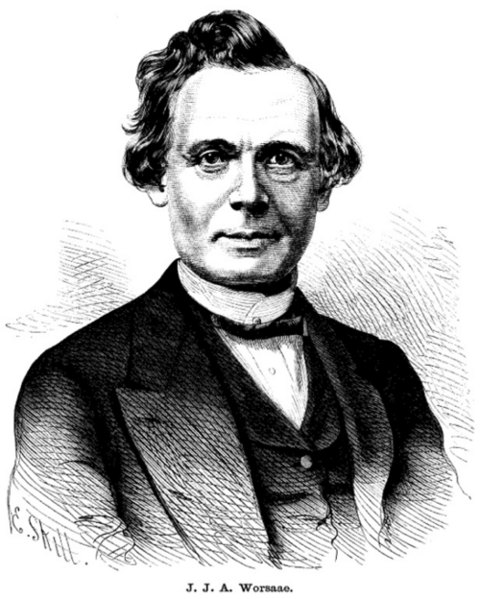
作者
Jens Jacob Asmussen Worsaae
1821–1885
- 出生
- 1821年3月14日, 瓦埃勒
- 逝世
- 1885年8月15日, 一座农场
- 国籍
- 丹麦王国
- 职业
- 人类学家, 考古学家, 史前史学家, 作家 和 历史学家
生平与作品
维基百科暂无该作者的中文条目。 以下为英语原文。
Jens Jacob Asmussen Worsaae (14 March 1821 – 15 August 1885) was a Danish archaeologist, historian and politician, who was the second director of the National Museum of Denmark (1865–1874). He played a key role in the foundation of scientific archaeology. Worsaae was the first to excavate and use stratigraphy to prove C. J. Thomsen's sequence of the Three-age system: Stone, Bronze, Iron. He was also a pioneer in the development of paleobotany through his excavation work in the peat bogs of Jutland. Worsaae served as Kultus Minister of Denmark (the cultural and education minister) for Christen Andreas Fonnesbech from 1874 to 1875.
Early life and education
Jens Jacob Asmussen Worsaae was born in Vejle, Denmark in 1821. He was the fifth of eleven children born into a wealthy, educated family. His father was a civil servant (a county treasurer) for the County of Vejle and also a member of the Royal Society of Northern Antiquities.
Worsaae's archaeological interests began in 1832 when his father gave him two stone axes, one which had been found on his land and the other having been found in the dredging of Vejle harbour. Worsaae was inspired; he began to search in on the east coast of Jutland before expanding his search area to include central and southern Jutland as well.
In 1835 whilst at school in Randers, Worsaae was invited to participate in an excavation of a grave at Bygholm, outside Horsens. Worsaae was also included in excavations near Jellinge the following year.
In 1838 he started studies at the University of Copenhagen, graduating in 1841. He was elected as a member to the American Philosophical Society in 1869.
文字: “Jens Jacob Asmussen Worsaae”, 来自自由的百科全书维基百科,许可协议为 CC BY-SA 4.0. 日期与资料:维基数据。
馆藏
Jens Jacob Asmussen Worsaae的图书
1 图书