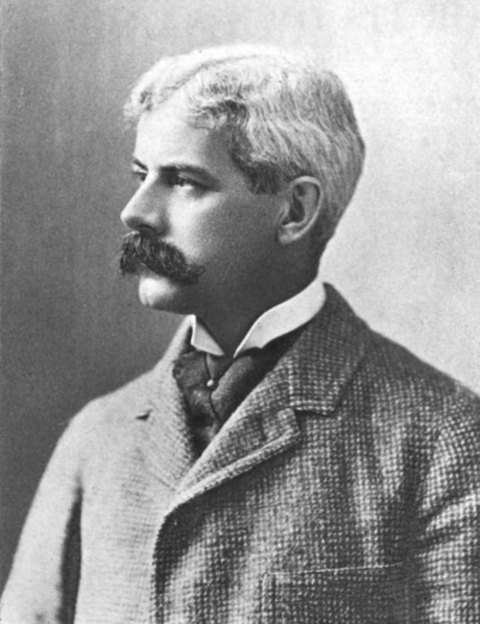
John Charles Van Dyke (1856–1932) was an American art historian, critic, and nature writer.
Biography
John Charles Van Dyke was born at New Brunswick, New Jersey on April 21, 1856. He studied at Columbia, and for many years in Europe. He was admitted to the New York State Bar Association in 1877, but never practiced law.
In 1878, Van Dyke was appointed the assistant librarian of the Gardner Sage Library at the New Brunswick Theological Seminary, and in 1886 as librarian. Russell Gasero describes him as one of those "extraordinary men who appear in the right place at the right time," and suggests that Van Dyke "developed Sage into the excellent research facility that it is today."
In 1891 Van Dyke also became professor of art history at Rutgers College (now Rutgers, The State University of New Jersey). With his appointment, the Rutgers president's residence was converted to classroom and studio space for the college's Department of Fine Arts. He was elected to the National Institute of Arts and Letters in 1908.
Van Dyke wrote a series of critical guide books: New Guides to Old Masters. He edited Modern French Masters (1896); Old Dutch and Flemish Masters (1901); Old English Masters; and a series of histories covering the history of art in America.
In 1901, he published The Desert: Further Studies in Natural Appearances. On its influence, historian Peter Wild wrote,
largely through The Desert the nation "discovered" the Southwest, its Indians, strange plants, and exotic animals. Discovered, too, the first and still the best book to praise the arid lands. After nearly a century Van Dyke remains the grandfather of almost all American desert writers.