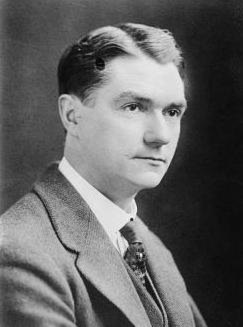
John Drinkwater (1 June 1882 – 25 March 1937) was an English poet and dramatist. He was known before World War 1 (also known as the Great War or WW1) as one of the Dymock poets, and his poetry was included in all five volumes of Georgian Poetry (edited by Edward Marsh, 1912–1922). After World War I, he achieved fame as a playwright and became closely associated with Birmingham Repertory Theatre.
Life and career
John Drinkwater was born in Leytonstone, Essex (now Greater London), to actor/author Albert Edwin Drinkwater (1851–1923) and Annie Beck (née Brown), and worked as an insurance clerk. In the period immediately before the First World War, he was one of the group of poets associated with the Gloucestershire village of Dymock, along with Rupert Brooke, Lascelles Abercrombie, Wilfrid Wilson Gibson and others.
In 1918, he had his first major success with his play Abraham Lincoln. He followed it with others in a similar vein, including Mary Stuart and Oliver Cromwell. In 1927, the George H. Doran Company published Drinkwater's book Oliver Cromwell: A Character Study.
He had published poetry since The Death of Leander in 1906; the first volume of his Collected Poems was published in 1923. He did also compile anthologies and wrote literary criticism (e.g. Swinburne: an estimate (1913)), and later became manager of Birmingham Repertory Theatre.
He married concert violinist Daisy Kennedy, the ex-wife of Benno Moiseiwitsch, in December 1924. Their daughter, Penny Drinkwater, went on to become a wine writer and member of the circle of wine writers.