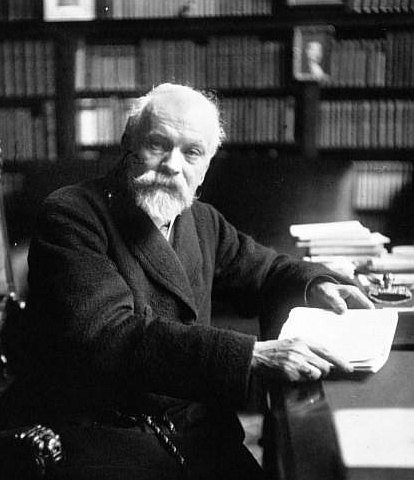
François Élie Jules Lemaître (27 April 1853 – 4 August 1914) was a French critic and dramatist.
Biography
Lemaître was born in Vennecy, Loiret. He became a professor at the University of Grenoble in 1883, but was already well known for his literary criticism, and in 1884 he resigned his position to devote his time to literature. Lemaître succeeded Jean-Jacques Weiss as drama critic of the Journal des Débats, and subsequently filled the same office on the Revue des Deux Mondes. His literary studies were collected under the title of Les Contemporains (7 series, 1886–99), and his dramatic feuilletons as Impressions de Théàtre (10 series, 1888–98).
Lemaître's sketches of modern authors show great insight and unexpected judgment as well as gaiety and originality of expression. He was admitted to the French Academy on 16 January 1896. Lemaître's political views were defined in La Campagne Nationaliste (1902), lectures delivered in the provinces by him and by Godefroy Cavaignac.
Lemaître conducted a nationalist campaign in the Écho de Paris, and was for some time president of the Ligue de la Patrie Française.
The Ligue originated in 1898 with three young academics, Louis Dausset, Gabriel Syveton and Henri Vaugeois, who wanted to show that Dreyfusism was not accepted by all at the university.
They launched a petition that attacked Émile Zola and what many saw as an internationalist, pacifist left-wing conspiracy.
Charles Maurras gained the interest of the writer Maurice Barrès, and the movement gained the support of three eminent personalities: the geographer Marcel Dubois, the poet François Coppée and the critic and Jules Lemaître.